

Photography Without Photographs
A Conversation with Natasha Chuk

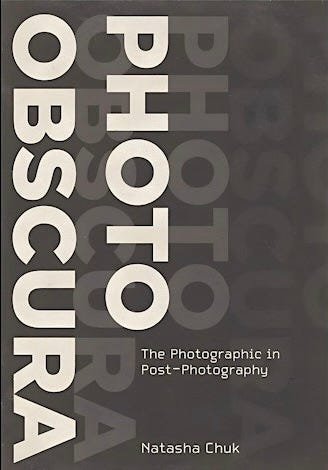
Natasha Chuk’s Photo Obscura: The Photographic in Post-Photography (Intellect Books) arrives at a moment when photography’s boundaries feel more porous than ever. Images are no longer anchored to cameras or observation, yet they continue to inform how we see and experience the world around us. What Chuk names as “post-photography” is not a rupture from photography so much as a reconfiguration, or transformation of its core mechanisms, as well as a way of understanding how photographic ways of seeing persist even when photographs, as we once knew them, are no longer evident.
Chuk draws together a wide range of contemporary practices, from hybrid physical–digital workflows to generative and computational imaging, and situates them within a longer photographic continuum that has always been entangled with mediation, manipulation, and belief. Some of the artists in the project include Maria Mavropoulou, whom I interviewed late last year, Sophie Kahn, Penelope Umbrico, Pascal Greco, Carla Gannis, among others.
As a media theorist, educator, and writer, Chuk has spent years considering photographic theory, pedagogy, and contemporary image practice, and teaches at the School of Visual Arts.
In our conversation, we talk about what remains photographic when the referent disappears, why students now treat their own images as raw source material for further transformation, the unfixed nature of history, and anti-images as a gesture of refusal.
D: Your book frames post-photography as a way of creating where the works may no longer resemble photographs yet still carry a photographic logic. How would you describe the core photographic impulse that survives in these post-photographic works, and why does that matter now?
N: I really appreciate the opportunity to talk about this work and about the state of photography right now, because our relationship to the photographic image is changing in profound ways. I think it’s important to acknowledge that shift and to develop more precise language for understanding what is genuinely new and what has simply been intensified or made more visible in the age of predominantly digital images, especially with the rise and accessibility of generative AI tools. When I describe post-photographic works as carrying a photographic logic without necessarily resembling photographs, I’m pointing to the impulse of trying to index, capture, or model the world using technical systems. Even when we’re not using cameras, and there isn’t a referent in the traditional sense, the works I talk about often retain photography’s core concerns with ties to the physical world and using new ways of producing evidence and articulating human experiences. I describe this as “photographic” to refer to various ways of structuring relationships between the world we inhabit, the machines/medium we’re using, and our own perception of things.
The persistence of photographic logic matters now because we’re at a moment when images are made with an increased distance from direct observation, yet they still circulate with realism and claims of authority. We are, yet again, faced with questions about photography’s ontology. For that reason, I include a discussion of generative AI, which I think exacerbates photography’s historical questions. It forces us to confront long-standing assumptions about photography’s relationship to authorship and truth, and how we define synthetic production. Post-photographic practices make those conditions visible. They help us think through the things that are genuinely new and what is simply an extension or a continuation of photography.
D: An increased distance to direct observation is a great way to put it. The DNA of photography is embedded in other processes, and the logic, as you say, persists.
You draw on a wide range of artists, from generative and AI-linked practices to hybrid physical/digital work. I imagine that your professorship alongside your years of research influenced how you think of the post-photographic. What kinds of student projects or questions helped you refine your thinking about where photography ends and post-photographic practice begins?
N: I think my media theory training has made me extra observant of the ways our behaviors are shaped by various media. Over the last decade or so, I’ve been attentive to the thresholds that separate different media, which are quite porous, especially as the medium tends to recede and give the impression of homogeneity when it becomes digital. The question of where photography ends and post-photography begins is an interesting one that I’m not sure I’ve adequately answered. I return again and again to the idea that photography has always been synthetic. From its earliest chemical and optical processes to its more recent computational forms, the act of image-making is complex. But I see the post-photographic as centering on certain shifts away from traditional photography while highlighting others.
I began noticing how photography students relate to photographic imagery, especially the “traditional” photographs they make with cameras or, more often, with their phones. In a way, these images are remarkably unprecious to them, which reflects our general tendency to take enormous numbers of photographs, almost diaristically. The fact that we keep all of them, in the cloud or wherever, suggests they have some value, but I think in general we don’t tend to hold individual images with the kind of reverence photography once encouraged. I think we find value in the accumulation of images and in the possibilities they carry to tell stories about us in some other way. Oftentimes, these image collections became raw material for new work, but not in the familiar post-internet mode of sourcing images from online platforms, like we see with Penelope Umbrico’s earlier work.
Instead, students are materially and conceptually dismantling their own banal photographs. They print them, layer them, draw over them, tear them, rephotograph them, re-layer them, and manipulate them to the point where any straightforward verisimilitude just disappears. They seem to seamlessly shift between digital and analog processes, undermining both at the same time. And yet, there is a photographic impulse that remains in this process. These kinds of works are still rooted in memory, indexicality, and lived experience, and their process informs a different way of thinking about Benjamin’s aura. This all amounts to a transition that feels more like “post-photography”, where the function has less to do with the image and its representationalism and more as a process of thinking, remembering, and registering the present. That, for me, is where post-photography begins to warrant its own identity. It’s when photography becomes an underlying logic rather than a recognizable form.
D: Why do you feel like switching between digital and analog undermines both at the same time? Do you think that’s because each process points to a specific reference point in photographic history and by taking an analog process and putting it up against something made now messes with the contextual understanding of that process, or reduces it to pure aesthetic? I’ve always wondered if there’s a way to handle anachronism in photographic processes in an elegant, conceptually clever way.
N: What I mean by this is there seems to be fluid movement between digital and analog processes without privileging one over the other, allowing each to complicate and destabilize the other. In that sense, there’s a refusal to treat either as more authentic or authoritative than the other. I see it as a way of suggesting that the “truth” of an experience (or our memory of it) isn’t limited to what the camera captures. The value of the source image is tied to the ways it indexes the world, but that’s just the starting point for becoming something more expressive.
D: One of the primary things I was thinking about when reading the book was, if I was in your position, how I would determine its organizing principles. You decided on dividing the chapters into recurring themes. Can you speak more to that decision making process and why you landed here, over say a chronology or another way of organizing?
N: Photo Obscura could’ve been written in a number of different ways. I love that about writing! It has an aspect of quantum thinking that encourages one of many paths to take hold. There are a few factors that contributed to this book’s organization. History is a big part of how I think and work, but I’ve never found that my critical observations fit neatly along a linear timeline. Instead, I tend to identify conceptual or perceptual effects that recur across different contexts, and then examine how particular technologies or conditions shape them in distinct ways. That’s the approach I took writing Photo Obscura. I never felt like it could or should follow a chronological arc, even though I reference critical moments in the history of photography throughout. For me, organizing this book’s ideas along a historical progression would have implied a kind of resolution or evolution that doesn’t feel true to what I’m saying about photography, which is that it has always been, in some sense, synthetic. From that perspective, the question for me isn’t whether images are synthetic, but how they come into form: which combinations of technical, material, and procedural processes produce a given image or image object.
A thematic structure made space for that way of thinking, and for the kinds of connections and frictions that emerge when history is treated as a set of entanglements. My aim is always to structure things like conversations, allowing different historical moments to surface as they become relevant to the questions we’re facing now, rather than treating history as something settled or fixed. Maybe organizing the book thematically instead of historically is a looser approach, but it also allows each chapter to be read independently, which is something I think about a lot as an educator who assigns chapters from books, and I didn’t want this book to read like a textbook or to have a didactic tone.
D: This makes a lot of sense to me, and I really enjoyed the overlapping of history, philosophy, and even psychology as all points of reference that shape your understanding of contemporary practice. What’s striking to me is how old post-photographic processes actually are at this point, assuming we agree that post-photography began when digital photography was born. To that end, you argue in the book that photographic practice is a continuation where new technology is introduced to that continuum all the time. For the sake of this conversation, the first digital camera was made in 1975, so we’re fifty-plus years into the post-photographic era if we are to pick a defining moment. With that, the book focuses on this particular moment in post-photographic history, which is different from, say, 1990 or the 2010s, which had a rush of artists working in Photoshop and the tools that were available at the time. I thought about digital painting as part of that earlier lineage, but it seems like what was most important was what defines this particular moment in time more than any other. Is that correct?
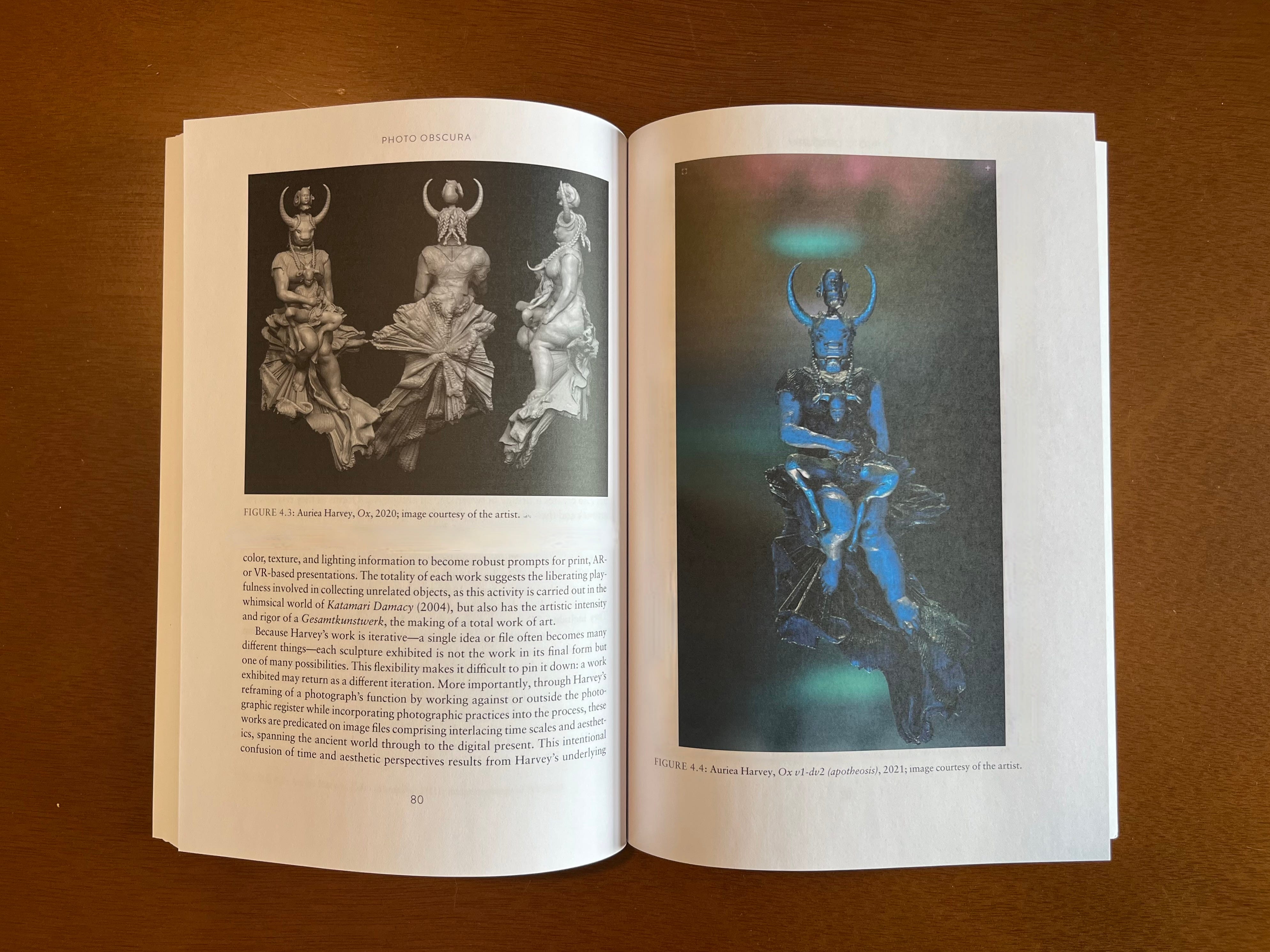
N: You’ve identified something really important about this history for me. While I do argue that photography exists along a continuum, where new technologies are continually folded into existing practices, I’m less interested in identifying a single technological rupture as the definitive start of the post-photographic. I think the invention of the digital camera in 1975 is a moment that matters historically, but it didn’t immediately produce a fundamental shift in how images functioned culturally, aesthetically, or conceptually. The moment this book focuses on is about the availability of new tools, but also a broader reconfiguration of the image ecosystem itself. The first wave of post-photography in the 90s to early 2000s was defined by artists experimenting with newly accessible software like Photoshop, and the internet brought a new way to appropriate existing images, but those practices often emphasized manipulation and a dramatic increase in scale while they still preserved the visual authority of the photograph. This book is interested in the conditions of today, where creative tools are combined to (further) blur the boundaries between photography, painting, sculpture, and other forms along the spectrum of representation and simulation. I also consider how this moment is additionally shaped by surveillance technologies, LLMs, operational images, and networked systems. I think it’s interesting that photographic thinking persists as a structuring method even when the resulting works may no longer resemble photographs at all.
D: What I find most compelling right now, over any other period in my adult life, is that it feels like we are going through a true paradigm shift in relation to modes of production. We’re all, not just artists, renegotiating our relationship to photographic images, and asking what responsibilities do they hold to the artists and people that make them and the audiences that consume them. Given that there is a focus on statistical, or generated, images in the book, I’m curious what you feel is at stake for artists when they adopt or engage with certain tools? Are artists responsible for making a commentary on the methodologies they engage with, or to comment on the evolution of the medium. I think there’s a certain criticality or at least self-awareness involved in the artist-technology relationship for thoughtful, deep work to occur, but maybe I’m wrong.
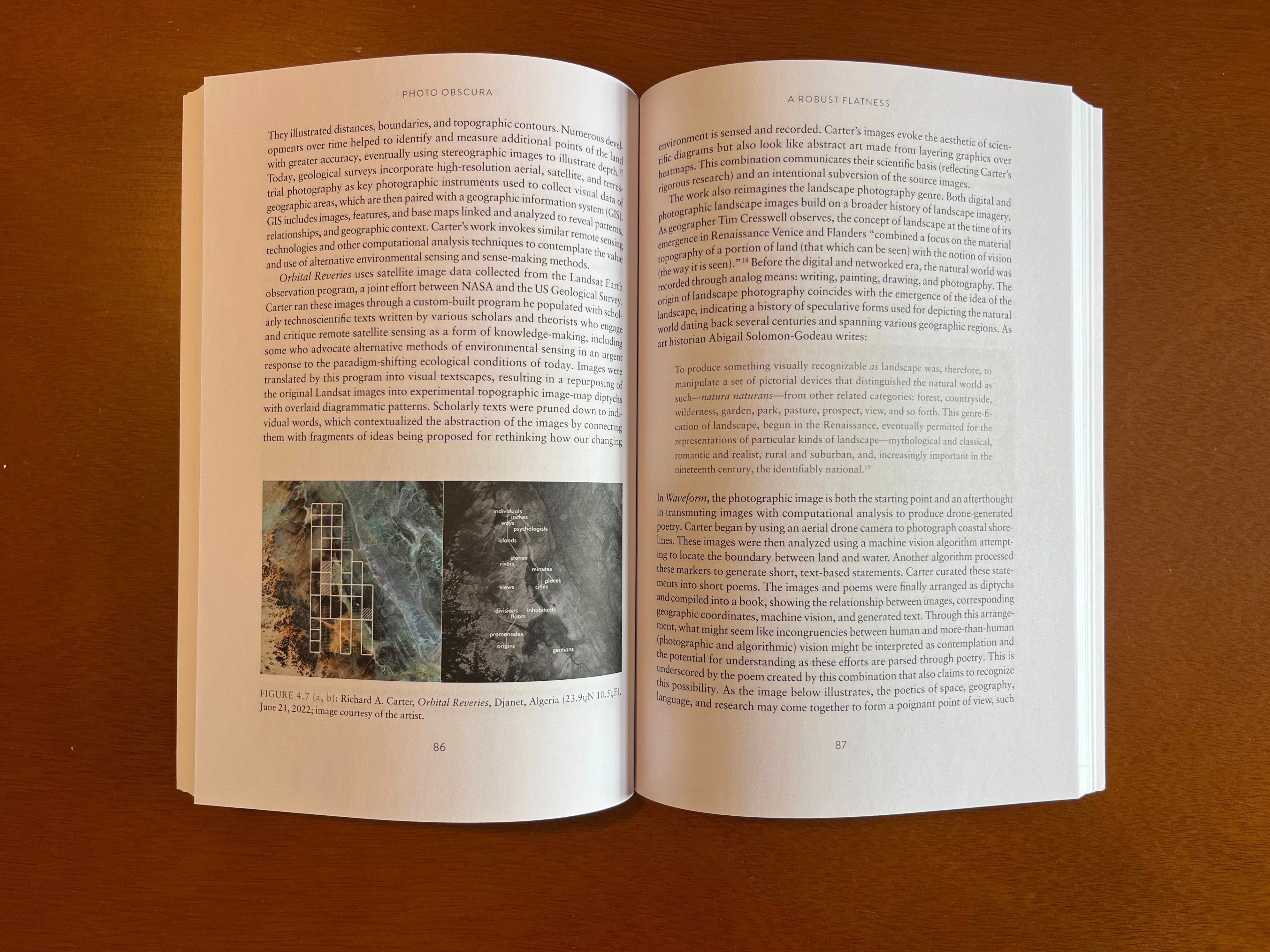
N: I think the best art offers something new or different to think about. Pushing various creative tools to reveal both their possibilities and their limits is itself a form of critique. Rosa Menkman’s work is a perfect example of exploring images as a way of thinking with technology rather than simply about it. It leaves you asking many questions about images and the technologies that make, store, and transmit them rather than finding simple answers.
Stephanie Dinkins draws on her background in photography to rethink what it means to document lived experience by working with small, deeply personal datasets. Her work counters the extractive, big data methods that dominate the existing machine-learning paradigms in favor of an imperfect transmission of histories that move relationally and locally. And the difference feels surprisingly human, almost like it achieves parity between us and the system. Menkman and Dinkins share a kind of inefficiency in the experience of their work that helps slow things down and gets us thinking. You can see this with many of the artists I feature in this book who refuse to treat the paradigm shift as inevitable or self-explanatory, and instead insist on shaping it from the inside.
Perhaps we should all feel a certain responsibility to think and act critically, as a matter of ethics and survival. Using these tools experimentally reveals what’s at stake in this paradigm shift, but I’m also in favor of refusal as a political gesture. Making an anti-image is powerful. Preferring not to is powerful. These, too, are options.
D: Yes, Menkman’s work with compression and file formats is a great example of a thoughtful way of engaging technology. Given the accelerating pace of computational imaging, do you think the term photography still holds analytical power, or does it risk becoming too broad? Early on in the book, you talk about liberating the medium from its truth-value, which I love. Mostly because photography has always lied. There are so many ways that photographs were constructed with the intent to mislead the viewer, from historical retouching practices to the construction of what’s in front of the camera to tell a different story. Notably, the story of Alexander Gardner and Mathew Brady’s The Home of a Rebel Sharpshooter is just one of countless examples. We should have never trusted photographs to begin with, and yet, we don’t really have any better truth-telling vehicle. As much as I am on the side of acknowledging the medium’s limitations, I do wonder if there is anything that can address objectivity better that also doesn’t fall prey to the same challenges.
N: For sure, photography was never a neutral truth-telling device, but it became our most persuasive one because it aligned so neatly with how we want evidence to look and feel. Even now, despite everything we know about manipulation, circulation, and context, we don’t really have a substitute that carries the same evidentiary weight. If photographs fail us, it’s not because they are uniquely deceptive, but because we asked them to carry an impossible burden of standing in for truth itself. Other analytical systems promise objectivity, but they introduce their own forms of bias and abstraction. We forget (or ignore) the perceptual capacity of any medium or system. No medium, tool, or system should replace critical thinking, but it’s too easy to let them do just that. We should be concerned with process and think about how or why something is made, circulated, interpreted, and so forth. This is as true for images as it is for language, advertisements, art, and everything else. Critical thinking is a kind of superpower. It forces us to slow down and explore how things are made to mean.
I appreciate the question about the descriptive accuracy of the term photography. I think it’s extremely broad. We throw it around without qualification, much like the way we use internet or AI. Many of its variations are conditional, too, with traditional photography being chief among them, but synthetic images, as I write in this book, is a problematic term, too. It’s easy to see how complicated it can get when you consider the range of possibilities involved in making images, but this is a problem that has existed for some time. For the record, I think post-photography is broad as well. I use it to cover an extremely wide range of practices and forms, but I do this with the goal of underlining the persistent relevance of photography and the “ways of seeing” embedded in our tools and systems that inform our understanding of the world around us. For me, this term’s primary function is to point out a work’s inconspicuous relationship to photography. From there, it inevitably overlaps with other categories.
D: When I think about photography’s relationship with technology, I also think about capital and power. Stephanie Dinkin’s work, as you mentioned, engages with big data. The book Capitalism and the Camera comes to mind, too, which is a collection of essays on how the medium is entangled in the project of resource extraction. There are other ways in which photographic tools are entrenched in economic systems. You mentioned earlier the value of artists experimentally engaging with tech as vital. What do you think are the risks and rewards of this kind of experimentation? Do you believe that capital informs aesthetic or ways of engagement more broadly?
N: I see Stephanie Dinkins’ practice as a more productive and more anti-capitalistic way of engaging machine learning. It’s intentionally grounded in small, bespoke data sets, which disavows the logics of scale, efficiency, and extraction that dominate most AI systems. The concern with extraction is something I also find compelling in Camera Geologica by Siobhan Angus, who contributed to the edited volume you mentioned. Given photography’s deep extractive history, it’s hard to imagine it as anywhere near neutral or immaterial, and I think this is true of any system that becomes a mechanism through which power is codified and reproduced. I’m reminded of an older book that left a lasting impression on me. Leonard Shlain’s The Alphabet Versus the Goddess argues that alphabetic writing fundamentally rewired human cognition, privileging linearity, abstraction, and sequential modes of thinking over image-based, embodied, and relational ways of knowing. He describes how this cognitive shift aligned with and reinforced patriarchal power structures, contributing to the suppression of goddess cultures and feminine epistemologies. It’s a compelling theory that speaks more broadly to how media systems of all kinds actively shape how knowledge, authority, and legitimacy are produced.
Photography and other forms of computational imaging can be understood in a similar way. These technologies don’t merely extract images or data; they determine what can be seen, measured, categorized, and ultimately believed. In that sense, the history of photographic extraction is inseparable from the consolidation of epistemic power. Perhaps the aesthetics of capitalism is about scale, seamlessness, and pushing extractive models. Speed is also part of this, which contributes to a sense of effortlessness, both in making and consuming things. This is where artists working critically with these technologies become especially important. Anyone intervening in the power structures embedded in these media is helping to destabilize their entrenched authority. The question is, what kind of cognitive shift are we currently undergoing? What kinds of thinking, relations, and power do these emerging technologies make possible or bring to an end?
D: Beyond simply calling something “photographic” or “AI-generated”, what do you see as the most urgent critical questions not just artists, but anyone consuming images, should be asking right now?
N: These days visual content exists in a dense, competitive ecology where AI-generated images, photographs, memes, advertisements, news items, screenshots, and simulations intermingle. They all circulate through the same platforms, vying for our attention. And it’s tricky because they share the same affective conditions of speed and compression. So beyond asking whether an image is photographic or AI-generated, maybe we could ask questions about its purpose or effect on us. Like what is this image doing to me, and what am I being asked to do with it? How is it asking for my time and trust, or my emotional investment? What kinds of behaviors or assumptions does it normalize simply through the use of repetition? These kinds of questions take us back to basics, to having awareness and exercising critical thinking. I feel like I focus a lot on speed and slowing down, but it’s the most effective way to study and evaluate something. In the attention economy, we’re not encouraged to think, just to act. So slowing down becomes a critical act that helps us look with more intention.
Another thing I think about is what disappears when images become abundant? When every moment can be visualized, or captured, or generated, what happens to memory, attention, and the care we offer ourselves and each other? And what gains power through the massive accumulation of information rather than through any single image? I think we need to ask how images represent the world, and also how they reorganize it. Images operate as interfaces for decision-making and for shaping our beliefs. Recognizing that can help move us away from debates about authenticity alone and toward a deeper understanding of agency, power, and responsibility. If critical thinking is our superpower, then nurturing higher levels of patience, skepticism, and curiosity when we confront images is one of the most profound responses we could have.
Brilliant conversation on how photography has shifted into something more procesual than representational. The observation about students treating their own images as unprecious raw material really nails what's happening rn--I've noticed this too when working with digital archives, where teh act of layering and dismantling becomes more meaningful than the original capture. It's like we're reconfiguring memory itself, not just images.