

A Pixel-Scale Mosaic
A Conversation with Maria Mavropoulou

Maria Mavropoulou’s work has consistently pushed at the edges of what the photographic medium can hold. Her most recent exhibition, Model Collapse: Love you, bye at the Archaeological Museum of Eretria as part of the program of the Greek Ministry of Culture, borrows its title from the phenomenon of AI systems degrading when trained on their own synthetic output, the show probes the risks of recursive image cultures and the fragility of human skills in the face of accelerating means of production. For Mavropoulou, the collapse is both a technical possibility and a cultural metaphor: what happens when our creative processes lean too heavily on machine-generated shortcuts?
In our conversation, we spoke about what’s lost in the translation from the physical to the digital, novelty seeking as a cultural phenomenon, and the ways artists can act as interpreters for audiences navigating the cultural anxiety of new technologies.
D: I want you to frame your relationship with photography first, not just as it pertains to cutting-edge vision technologies. What’s your background, and how did you arrive where you are in your practice?
M: I was stuck with the label of photographer for a while, although I studied fine arts, and my background is painting. In school, I had a photo-realistic style. I intended to achieve a mechanical, hyperreal look to my work with no visible brush strokes. Then I started using photography, but I realized that photography can be very subjective, too, like painting. This is how my journey with photography started, and gradually I began trying out newer technologies like virtual reality, which are actually made from photographic parts. So it’s like a big JPEG file that has a specific ratio, and then the program turns it into a sphere, so that while you’re wearing a headset, you feel like you’re inside the image. It’s an embodied experience that was something I didn’t get from photography alone.
It made sense to me to follow the evolution of technology and see how it changes our physical relationship with it. But we still experience 3D environments through screens, so they remain kind of two-dimensional, or separate from the body. I was looking into what gets lost in the translation from the physical to the digital, what senses could never be available in that virtual space.
It was during COVID that I was documenting my surroundings and the places I used to go for walks. Nature has cycles, and every day you see different flowers blooming and then withering and all that. This cycle—the aliveness of the physical world—cannot be translated because everything is fixed online. There’s not that feeling of chance or timing; everything is there forever.
Then I tried out AI, early GANs, experimenting a little bit with my own archives and making images. Since I was really early to embark on that AI train, I was one of the first artists invited to try out DALL-E.
D: Do you think there’s, in your mind, a relationship to you exploring AI and COVID, and the fact that COVID informed how you think about your creative practice? As a photographer, there’s often an embedded social component to photography, and we’re dependent on working with a team of people to produce images. Do you feel like COVID pushed you in a direction to explore AI that you maybe wouldn’t have otherwise, because the social aspect of image-making was gone, or was that just circumstantial?
M: No, I wouldn’t say that. I experimented with generative adversarial networks in 2019, already. I was very tired of photography at that point. I felt that everything had already been photographed. So what’s the point? And AI seemed promising, in my mind, because it recycles what is already there.
For many people, COVID changed their daily routines, but I was already spending so many hours on the screen. Plus, I live in the suburbs, so I work from home. I live in a place where I have forests around the house, so COVID didn’t change much for my daily life. It was just that I had less pressure for work, no deadlines, and I was open to experimentation. The direction I wanted to go was clear already, but now I had the time for it. COVID forced our relationship with the screen because everybody was in the same situation.
D: I was thinking about something you said earlier about feeling tired of photography, and that really resonates with me. I’ve likened this feeling to a need for novelty, because in my own practice I think a lot about whether it’s possible for photography—or its tools—to still show us something new. That sense of wonder, or that there’s possibility, is a bit lost now, given how prolific the medium is. Which is why I find it so telling that once AI became photo-realistic, or nearly so, many photographers rushed to explore it. I wonder how much of that’s tied to the pursuit of novelty. Do you see novelty as something that matters in your practice, or is it less important to you?
M: I’m always interested in new ways that images can be created. So in that sense, yes, I’m attracted to new opportunities that it might give, but it’s not about being trendy for me. It’s about trying to think in the future and project how it might impact us, the users of that technology, and highlighting, you know, the limitations or the strengths or the problematic aspects of the new medium.
I, personally, was not very concerned about the photo-realistic aspect. I didn’t wait for it to be perfect to use it, because I feel that even the distortions it had could express different feelings, possibilities. As an example, Charlie Engman’s work, which is all about that, the eerie, uncanny feeling. Paintings don’t require realism to spark feelings; why should any other medium?
D: Yeah, I find myself more attracted to the aesthetic of the older AI technologies, because there’s a hallucinatory, associative quality. And it is, in some ways, to bring it back to the beginning of the conversation, closer to painting, because there’s room for the viewer to put themselves in the image. Those hyperreal images are illustrative rather than expansive. How do you decide what technologies to use, and at what point do you feel resolved about the tool and you’re ready to move on?
M: I’m very open to going back and forth. It’s been a while since I last painted. I stopped around 2014, and then I painted again in 2020, and who knows, I might paint again. I never say, Oh, it’s old. I don’t need that. But since technology evolves so fast, I’m compelled to follow where it goes to some extent. I just like to have a big toolbox and whatever tool works best for the idea I have in my mind.
D: How important is it for you that you enjoy the process of using a particular tool set? For instance, I actually don’t like the process of using text-to-image generators, even though I’m actively working with them. Is that something that matters to you, or is it just the curiosity of trying to understand a new process of working?
M: The process becomes fun for me, actually. As an example, when I was making Imagined Images, the family photo album project, I very frequently had moments where I was like, Oh my God. It’s my own family history, and I’ve never seen that before.
Many of the source images from my family were lost because my parents and grandparents immigrated, so I would frequently have my mother sit next to me and ask her to share some memories.
I would pick thirty or so images from a specific prompt, and then I’d ask her, How does she remember that? Then she would choose the right image, the one that I’m including, for the final project. So for me, the process was very emotional. And the audience has also had that experience of being very moved. I’ve had people leave in tears from experiences, which was very touching.
D: That makes sense to me, although I don’t share the same experience. I often find that part of being a very curious person is that I’m fighting with the tools, like, I don’t know how I feel until I start using them, and then I’m invested in figuring out how they work, regardless of how I feel. Sometimes I’ll have aha moments, and I feel like I’m in a flow state, and sometimes I don’t. If I were to define my practice, it’s about the struggle for control, so it’s very comforting and refreshing to hear that you have a sense of pleasure in the process, and that potentially translates to the audience.
M: When they don’t please me, those are the projects or the ideas that I don’t go forward with. I mean, what’s the point? This is how I feel, and I’m the first viewer.
D: In the last film project, The Sleight of Hand Machine, you go into the black box nature of AI technologies. There’s a literal and metaphorical pulling back of the curtain to show the mechanics. How important is it for you to talk about the politics of how certain technologies work?
M: My first intention in trying out new tools is to understand them. Most of my work refers back to the medium I usually create with. This is something that I didn’t realize at the beginning, but it’s something very persistent in my work. In the case of the film, it’s especially relevant. I feel an obligation to show their inner workings both for my own understanding and for the general public as well.
D: I had a conversation a decade ago with a friend who’s a painter about this, and something he said stuck with me ever since. His thought was, Why does it matter what brushes I use? But I would argue that in some ways, photography and painting are very different beasts with respect to this. I don’t want to say there’s an obligation for us as photographers to talk about the medium, but I think because our medium changes paradigms in response to the culture and in response to technology, I almost feel like we have the opportunity to address the elephant in the room.
M: When I’m photographing, I’m not saying which camera model I used because it doesn’t matter. It doesn’t make any difference because I’m the operator, I’m the user. These are my decisions, but when you are working with AI, there’s you, the operator, and AI, which has its own agenda in the creative process.
These tools are not simple. They are very elaborate, complex tools that have their own agency and their own intention. Brush strokes only have the bias of the painter, but that’s not the case with AI. It took me many years to come to the same conclusion that you just did there, that some fundamental differences are quite important.
D: There have been a couple of times over the years when I’ve spoken publicly, and I could sense how scared, confused, and hungry people were to understand this cultural moment. Artists are at this really pivotal place where we’re very good at translating for people what this means. I do think there’s an opportunity there for someone like yourself to be a translator, and it doesn’t always have to be like you’re in a place of being a teacher all the time.
To that end, I know you teach workshops on occasion, and so you have a bit of a mind for the responsibility of an artist to do that kind of work in a more formal setting. What are the things that you’re thinking about as an educator when you’re teaching AI and photography together?
M: I like to start by saying that I’m not pro AI. First of all, I’m not an optimist, but I’m trying to look at what’s happening. I always say to the students there’s no point in refusing AI, or any other technology. Pretending it doesn’t exist, out of fear or ignorance, is not a good approach. I say try it, understand it, and then, of course, you are free to reject it. That’s absolutely okay.
I usually teach photography classes, so they’re artists first. I say, AI images are just another kind of image. What’s important is that when you make a painting or when you make a photograph, there’s meaning in your images. So what’s that meaning? What do you want to say to your audience? It’s just another artistic tool, and then you have to be critical to work that tool. I find it very, very important to let the students understand that intention is something they should preserve for themselves.
When we let AI guide the conversation, let it create whatever it feels, this is like letting go of the intention. Art is about translating your own experiences through a form and then communicating that to your viewers. Art is made by humans to be seen by other humans. Of course, we might use tools to do that, but it’s still a conversation between humans.
D: I have two thoughts here: One is that curiosity is at the heart of being an artist. It’s not our obligation, but they’re the same. Being an artist is to be curious. And so I have always been quite shocked by photographers. Photographers who are adverse to thinking outside of the narrow canon of how things are done and made. It’s refreshing to hear you say, both in your practice and when talking to students, how you approach your work like a researcher, open to where the research takes you.
Oftentimes, I’m surprised by how many assumptions some artists bring to the creative process. For me to even have an opinion about anything, I have to have some skin in the game, which is kind of what you were getting at here. For you to develop an opinion, you have to use it, you have to participate, and then decide whether or not it’s something that you advocate for, or acknowledge that it’s really problematic, or more likely, somewhere in between. More often than not, there’s a gray zone, but the only way to really acknowledge that or to go deeper and understand to what degree something is problematic, you need to get your hands dirty. I think part of the soapbox that I’m on in my own life is that I want people, whether they’re artists or not, to be more curious about the world because that’s actually how we evolve, grow.
You mentioned intention, and how there’s a language encoded in AI images in the same way there’s a language encoded in photography. I’ve heard you quoted as saying that ‘AI images are ontologically equal to photographs’. Could you speak to that a little bit more?
M: People frequently say, Oh, these are fake images. I mean, fake what? They are what they are; they are just images. No image is actually true. We used to need some solid ground to talk about truth as a society, and photography gave us that solid ground. But we soon realized that photography is not a solid ground and that it can also be tweaked to show the skewed reality of the photographer. The tool might be objective, but the operator is absolutely not objective.
So, yeah, I feel that AI images are also ontologically equal to any other kind of image, in the sense that they are also generated images. Paintings are also generated images. They are just generated from a mind, the mind of a painter, the heart of a painter, and now they are generated from a machine, still with a human operator. If you look back in art history, paintings were actually commissioned by the church and by kings in order to create a specific kind of narrative that would be used to communicate a specific message to the people. The images you would see in the palace or in the church were considered the absolute truth. But you know, what connection do they really have to the truth? Is it just the truth that the king wanted to impose on the people?
I’ve also said that AI images are derivatives of photography, because they’re recycled photography, but it’s very different because they have no connections to time in the same way photography is connected to time.
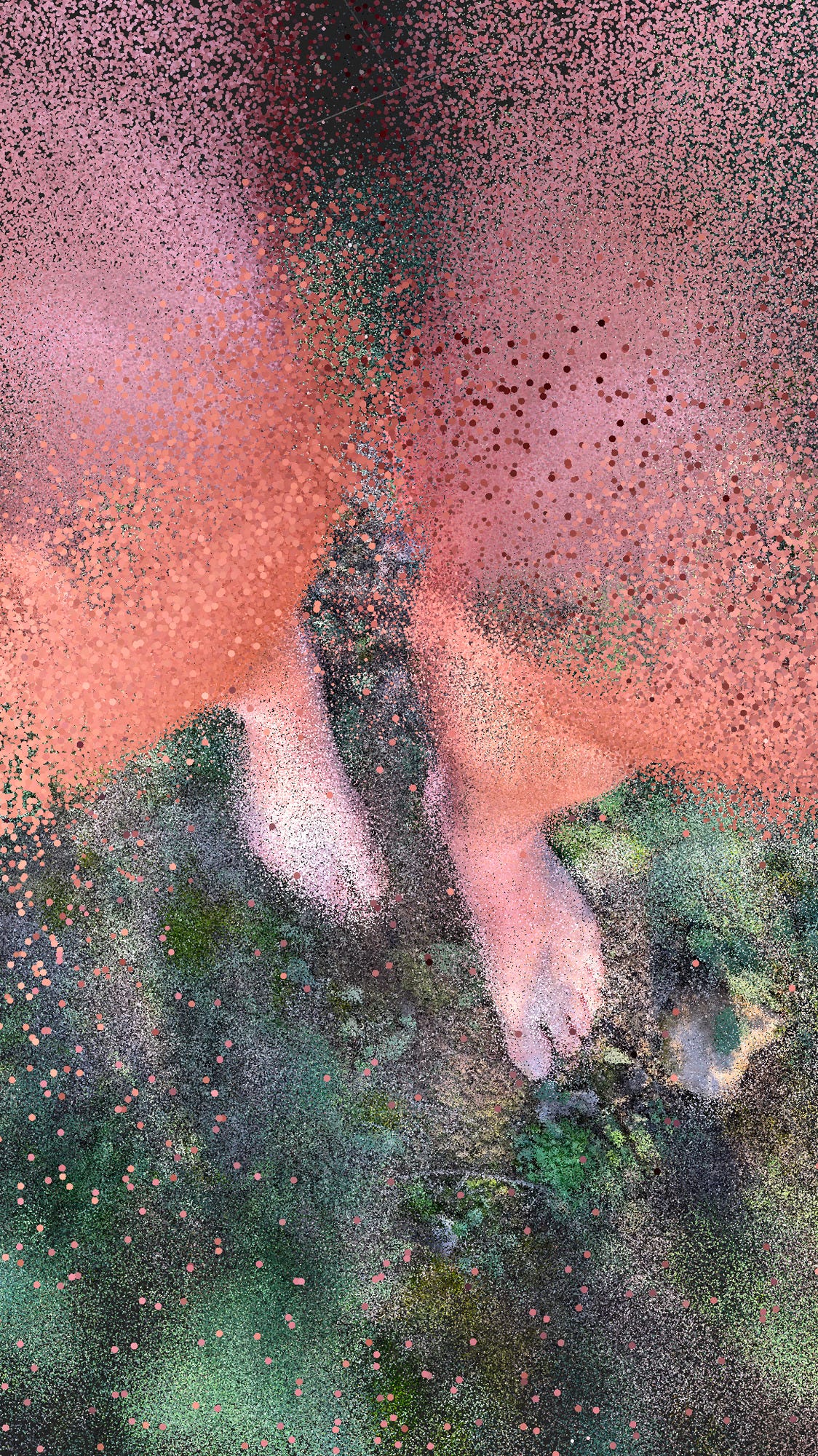
D: Do you think AI images are closer to collage than? Technically speaking, collage isn’t the most accurate comparison to latent space (the multi-dimensional space of the dataset that creates associations between images and ideas, then measures the distance between those associations and creates a mapping of how images-ideas relate to one another), unless we think of them as a kind of collage at the pixel or atomic level. In that sense, maybe they’re closer to stippling or even mosaic. In any case, we don’t look at a collage or a mosaic where the source material comes from a photographic archive, and think of it as stealing the creative labor of artists, because something is transformed in the creation of the new image.
In terms of the IP debate, this argument makes the most sense for famous artists or prolific work where a particular artist is heavily featured within a given dataset. But for most living, lesser-known artists, I’m more skeptical. The way AI functions feels less like lifting a style wholesale and more like blending everything into an indecipherable stew. All that material is flattened into an average rather than replicating any one artist directly. Unless again, you’re prolific. Still, it raises slippery and important questions about intellectual property—how much of a particular artist’s work is embedded in a given output, and whether resemblance is enough to claim exploitation. I want to see how this debate evolves, both in terms of legislation and how artists themselves come to reckon with what’s being borrowed, remixed, or lost. At what point is something transformed enough to be considered unique, or not derivative?
M: Yeah, it’s a very complicated topic, because it’s different when you are a very famous working living artist, and you are still making your living from that work, which we have seen already. I have arguments for both sides.
For example, I started in an art school, like many other artists. We’re trained on other artists’ work. So we do look at other artists. We might even try to copy them to learn. We go to exhibitions, we see shows, films, and movies, and listen to music. We consume culture to produce, so it’s normal, in a way, to steal.
The counterargument, one of many, is the lawsuit between the New York Times, which is pursuing OpenAI for using its copyrighted material to train its models. I’ve collaborated with OpenAI myself. They’ve given me access to different tools, but I also work as a journalist and have work published in The New York Times. I mean, it’s a problem that AI companies don’t compensate people who are actually making this new content that has been made on the backs of people. This creates revenue in order to keep photographers and journalists writing articles that are needed to spread the news. This is also a specific economic model. The economic model of these corporations, the media, that’s how they work.
Personally, I wish OpenAI didn’t charge a subscription. They use everybody’s data, and then they make you pay for it. I think we should find different solutions, like if you scrape everything, you should give it back to the users. I guess we don’t all contribute in the same way to the data set. Some people have never created anything, and there are people who have contributed large amounts of content, so it’s not equal. Nevertheless, there should be a way to compensate the people who have contributed.
D: What this really highlights—and I haven’t fully worked it out yet, but you’ve touched on it—is that there are two different issues: one is the creative authorship side. Whether making art is an innately unique process. As you mentioned earlier, in art school, we’re trained by looking at other artists, imitating, and figuring out what we respond to. I’d go even further to argue that the emphasis on originality is a very Western way of thinking. In many Eastern traditions, imitation is central to how art is made and valued. So in that sense, the debate around authorship is further complicated.
The other issue is economic: who benefits from all this free creative labor? That extends far beyond the arts, but it certainly impacts artists. Large companies extracting data and profiting from it without compensation is troubling. Artists, in particular, are required to share their work online to be seen, but that prerequisite makes us vulnerable to exploitation. Which brings me back to something you mentioned: working as a fine artist, an educator, and a commercial photographer. On the surface, they might seem like facets of the same field, but in reality, those roles operate differently. How do you balance your many hats, and how do you reconcile the demands of these different industries?
M: I always say I do two jobs. When I worked for The New York Times, I had a journalist mindset; there are rules to how you photograph things and how you approach your work. It’s so important to be as objective and careful when you’re doing this kind of photography. Although I’m not covering news or conflict zones, I’m covering cultural events.
When I work on my own things, I have the freedom of an artist. I would say that photojournalism is more connected to truth, but I would argue that there’s a lot of imagination involved, too. In some ways, it speaks to a different kind of truth, one that has a perspective or a viewpoint. But still, even when I make AI images, I’m not trying to fool anybody. I’m just trying to make things that are difficult to represent.
D: I have this theory about art making that I’m not sure if it’s correct, but there’s something about it that I want to explore, which is that good art involves some kind of risk-taking, and this could be just what an artist puts on the line procedurally, emotionally, physically, so forth. I personally feel cautious about processes that make the job of the artist faster and easier, which is only to say that there’s something important about the labor of doing because it’s through the doing, however challenging it may be, that we learn about how we feel.
On the other hand, I am very much an advocate of tools being democratized and everyone being allowed to be creative, because I think creativity is innately human. Like we should all be able to tap into our own creative impulse, without needing to qualify the goodness of the work produced. I guess the question is, and I know it’s kind of a big one, but what is at stake for you as an artist in the art-making process, and what qualifies something as being good art, or maybe the phrasing is good enough art?
M: I don’t know. I think good art is something you feel when you see it. I mean, there’s no recipe. I don’t know the recipe, at least, but I would say it has something to do with bold ideas, good timing, and eliciting emotions in people—good art kind of moves you. It’s like, Oh, my God, yes, yes. You know, I can feel that.