

Evading Capture
A Conversation with Sophie Kahn

I don’t remember how we first met, but over the last fifteen or so years, Sophie Kahn and I have discussed the many ways that artists co-opt the photographic medium for other purposes.
She makes sculptures, prints, and sometimes screen and web-based works fashioned from photographic scans of the body. Some of her work is grounded in her own experience of chronic illness, most of it, though, is an act of sustained engagement with the bodies of others, and with the history of how imaging technologies have been used to codify and flatten the human form. Recent work includes Transfigured, a series of sculptural portraits of people who have undergone life-altering physical transformations, developed through intimate, relational studio encounters, and Ghost Variations, an augmented reality commission for David Geffen Hall at Lincoln Center. She is a New York Foundation for the Arts Digital and Electronic Arts Fellow, and has taught at Pratt Institute, NYU, and Columbia College Chicago.
In our conversation, we talk about what it looks like to build a practice around productive failure rather than productive output, the question of how much of a subject’s story needs to surface in order to be understood, and why the best moments in a studio practice often happen before you know what you’re doing.
DE: The scanner you use was designed for a very precise and specific kind of capture, but much of your work, be it sculpture or digital rendering or prints, directs the viewer’s attention to the artifacts of the technology. Can you speak to why this is important and what led you to this way of working?
SK: I should preface this by saying that my work is not really a very sharp critique of imaging technology these days, just from a totally technical standpoint, because there are fantastic scanners out there now, but there’s something about this aesthetic that I’m really kind of wedded to, and is endlessly surprising for me, and keeps me working with it.
So, I did photography for my undergrad. I did the work that I really loved when I was a teenager, when I was falling in love with the medium [of photography], where people like, you know, Diane Arbus and Robert Frank, or people who are working with 35mm on the street, and there was an embodiment to that that was always incredibly important to me. Diane Arbus was one of my heroes, and I felt she put herself into her work, and she had these relationships with her subjects that were a huge part of what she was doing. So I really reacted against the trends in photography that were around when I was in undergrad, like Andreas Gursky, whose work was disembodied and very remote, like a mechanical eye.
When I was doing architectural photography, I realized I actually wanted to be kind of intervening in the spaces of the buildings that I was photographing, like I the idea of being able to render them and then change the material to glass and be able to see through them, or the idea of being able to place an imaginary camera anywhere, you know, so I learned 3D modeling.
This imaginary playground for photography was really intriguing to me, and so I actually went to architecture school, just for a year, to learn 3D. Then when I was there, the department I was working in had this particular scanner. This was 20 years ago, and they were using it to reverse engineer Gaudi’s original maquettes to finish the Sagrada Familia. So it would go back and forth to Barcelona, and then when it was in Melbourne, I would get to use it and play with it. And I wasn’t that interested in direct reproductions. For me, scanning bodies and faces was this sense of like there was creative discovery.
There was the idea that you’re bringing together two opposing conditions and then creating some kind of static and friction between them, and you never know what’s going to happen in that space.
So that has kept me intrigued, I guess, in the decades since. This would have been 2003 so we’re talking like 23 years ago at that point. That’s the little origin story.
DE: That’s incredible. It’s interesting that you say that the commentary on the technology is not really so present in the work anymore, and it sounds like you’re saying that because the technology has gotten so good that there’s not really a need to have that conversation. Is that correct?
SK: Yeah, it’s not the most interesting part of the conversation for me. Because otherwise, you’re just doing a tech demo, or you’re doing the opposite of a tech demo, but it’s still a tech demo, you know, like, there wouldn’t be a big difference between somebody public going on, like, Wirecutter and publishing a review and being like–hey, this thing sucks.
DE: Well, I do wonder with that because of our relationship and how pervasive AI is right now, where that technology is a black box, and it’s harder–although not impossible, but harder–for artists to pick the technology apart. There’s something that I gravitate towards, personally, with respect to having enough agency over my tools, which allows me to dissect them, as a commentary about perception.
SK: Yeah, I agree. I’m not really using AI tools in my work, and it feels important to me to be using these devices that are from a very particular era, but to continue to investigate that, and to continue to push that and find what I can get out of it.
But you’re absolutely right. There are a fairly limited number of parameters within the scanner I use, and within the software, and it’s very clear to see what the assumptions were that underlie the design. There are simple assumptions, and they’re simple to challenge. I agree with you, it’s kind of almost too slippery with AI, and so many of the assumptions and the biases and things that are baked in are so subtle. So I have just found more mileage myself where I am. Also, in having human presence in the studio, and that has maybe been the real evolution in my work, is working with models who have specific narratives, and I’m trying to represent those narratives, you know, honoring these people. Do justice to their stories.
That wouldn’t work in the same way for me if I weren’t using this really indexical technology, where they’re there standing right in front of me, and then I have a device, and the light goes right on their skin, and then that gets bounced into the lens of the scanner. And it’s very direct, it’s very similar to photography. There’s light, there’s the lens, it’s made in a specific moment in time, and that, all of that has just remained very important. And I don’t want to add any more layers of distance between me and my human subjects.
DE: This is something that we talked about at length when I visited your studio two weeks ago, which is how important the stories of your subjects are, and how important honoring the subject is. And that’s something that maybe a viewer, coming blind to your work, might not notice or might not realize that that’s part of the conversation. So I’d love for you to speak about the idea of the fragile body, the transformed body, or the body in motion, and what that means to you. I know you’re actively working through how to address the privacy and ethical considerations of working with sensitive material, but also from an interpersonal perspective, since perhaps, as you say, the technology is secondary to this human component.
SK: I’ll first recap the body of work, Transfigured, that we were talking about, just to kind of catch people up on that part of the conversation. But it’s been ongoing. It’s really been, I want to say, since I actually started the project in 2019, and then it got shelved for several years because I couldn’t have people physically in my space because of COVID.
I literally just did an Instagram post, and I invited anybody who felt that they had undergone a life-altering physical transformation, and wanted to model for me and tell their story, you know, visually, by posing and being a part of the project to reach out. I think I have about 25 people who came to me, and the stories were really, really amazing. It was an incredible range.
Some changes were very joyfully chosen. You know, there was a friend of mine who was pregnant with twins, and there were people who were working through various medical stages of transition. And then some changes were quite unwelcome, like people who’d been in car accidents or who’d experienced cancer or illnesses or surgeries, people who had had congenital skeletal issues that had been surgically fixed. Your bodybuilder, 911 survivor, I think the stories really ran the gamut, and I drew on a lot of my own bodily experiences, too.
I have a history of chronic illness and disability. I don’t identify as somebody with a disability now, but I lost a fair few years of my 20s to chronic fatigue syndrome, and so that was something that was really invisible, which was a whole other kind of set of questions. And then I’d been through pregnancy, and I’d been through surgery, and there were so many points of connection that I was able to find with people who had incredibly different life experiences from my own, and they were these very vulnerable people. I was so honored that people would come in and share all of this with me.
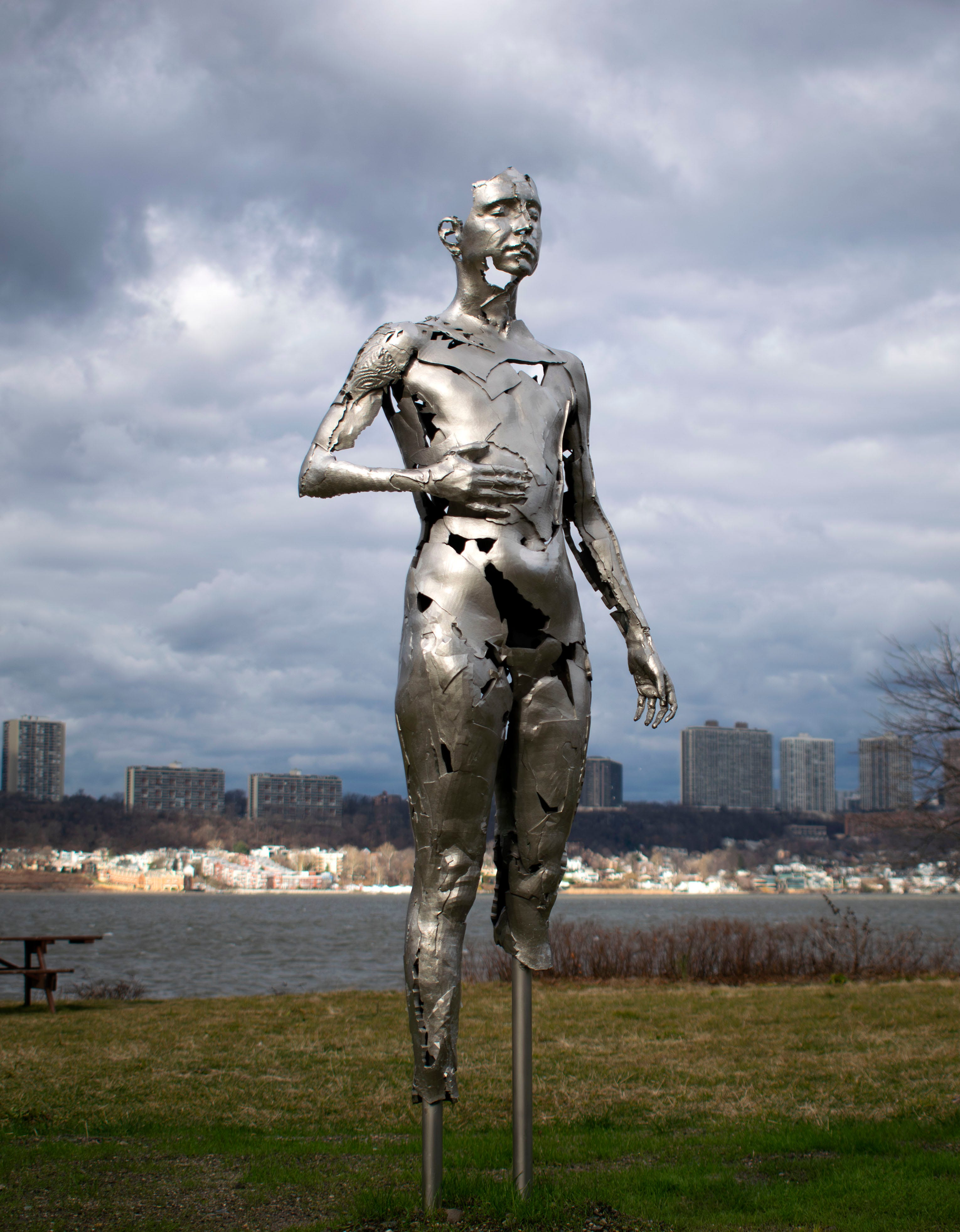
In the Portrait of t, which was the public sculpture that was commissioned, that was the first piece that fully materialized to the degree that I wanted from the project. The model had found out that they were carriers of the BRCA gene and they needed a preventative mastectomy. They’d originally come to me with their own idea to be scanned before and after their surgery. They’re also a performance artist and a musician, and wanted to create a work around their own body. Then, when I started this project, they were the first people that I thought of.
The pose is a very serene and graceful gesture. I think they said that it was based on looking in the mirror right after the surgery, and just looking at the change in their body. Their hand is right here on the chest. I was also conscious that I was asking people to relive and perform some, in some cases, really hard things that had happened to them. I wanted to make it a very safe space. I wanted to be really clear with all my models about how they were going to be represented. I wanted to give them a sense of how things were going to look. I didn’t want anybody to be surprised by what the final images looked like. And I wanted people to feel good about the amount of information I was conveying with each one, because some of it was very sensitive medical information, too.
I was so stressed about the ethics and, like, not wanting anybody to feel exposed, but I’m in conversation with a lot of the people who pose still, and I think I would like to go back and get audio and interviews and decide how much more of the story needs to be surfaced for the work to be legible. Because that’s always such a huge question, as to how people are coming to an artwork, and how much do you need to say for them to take away something from it?
There’s part of me that loves the idea that there’s no specificity, but that through the pose and through the emotion and the gesture, there are a lot of qualities that come through, and there’s kind of ambiguity in questions that intrigue the viewer. I think there’s merit to that, and then, there’s also merit to thinking about it as in much more of a storytelling context.
I almost think it needs to be addressed individually with each work. It might even need to be case by case, and have the blessing from people before I say anything particular about them. But I mean, these are big questions in photography too. To bring it back to Diane Arbus, the ethics of how she was using the images of her subjects has been called into question quite a bit over the years. Was it exploitative? What was her role in their representation? Was she just kind of trying to scandalize an audience by presenting such extreme walks of life? From everything I read about her, she treasured her relationships with her subjects, and she went very deep into their worlds. But there is always a challenge when you have an image of another person. I think you can’t get around that.
DE: Especially when it comes to images that really point to the index. And if we are framing your work, for lack of a better word, in the context of documentary photography, or photography with a capital P, which is something that I never really think about when I think about your work, but I love that you are thinking about it, and it makes sense in the context that undergirds your concerns.
SK: I have a subset of these pieces that are painted with skin tones, and I’m painting the tattoos, and the tattoos have been stamped on in ZBrush. It’s not present in the scan, but I photographed and cataloged everybody’s tattoos and turned those into little alpha maps. This created a raised image on the skin, a kind of embossed effect, or a stamped in effect. And I have some works that I’m going to do full skin tone painting and do the tattoos like a black or a navy, and I had considered doing something like that for an outdoor installation, but the piece looked too exposed.
DE: The story that I told you when I visited the piece on the Upper West Side. As I walked over this bridge and looked down into the garden where the sculpture was, you see the piece from a distance, which is always such a treat to see anything from a distance in New York City. To get that kind of perspective.
SK: The catwalk, right, the sky bridge over Riverside Drive, no, the West Side Highway, yeah, but you’re seeing it from 50 feet above and really small, and there’s a huge amount of space around it.
DE: So, just seeing essentially, a nude body from a distance, one might be like, What is going on here? Like you said, the material choices that are made and what that requires of you beforehand, to think about the context in which the work is placed.
SK: In the end, that piece was cast in bronze, and we did a nickel plate, because I really wanted a sort of steely aluminum look, but the aluminum was too delicate. It ended up looking like armor plates, you know, like these overlapping shells that almost seemed like they would move with movement, or like a fish scale or something. So the work seemed more protected because of the metal finish. And it’s also a lauded material by the art world, you know, like bronze, which puts the world within a very long tradition because of the material choice.
I feel like I’m harkening back to these kinds of outdated ideas of photography, in a way, too. But I guess it’s, it’s the photography that I grew up with, and that was my thinking as a really, as a young person, and I feel like as artists, it’s actually really important to stay in touch with what we loved when we were young. I try to come back to that when I get too jaded.
DE: I think that’s the most surprising thing about this conversation so far for me, is that relationship that you have right there. I wasn’t thinking that would even be part of the conversation, but I actually find it quite refreshing, because I don’t think most people talk about that genealogy very often when they are that far removed. And in some ways this is kind of what Natasha Chuk’s book talks about the DNA of photography in newer tech. And so those things are still, even if they’re abstracted, they are still embedded in the process.
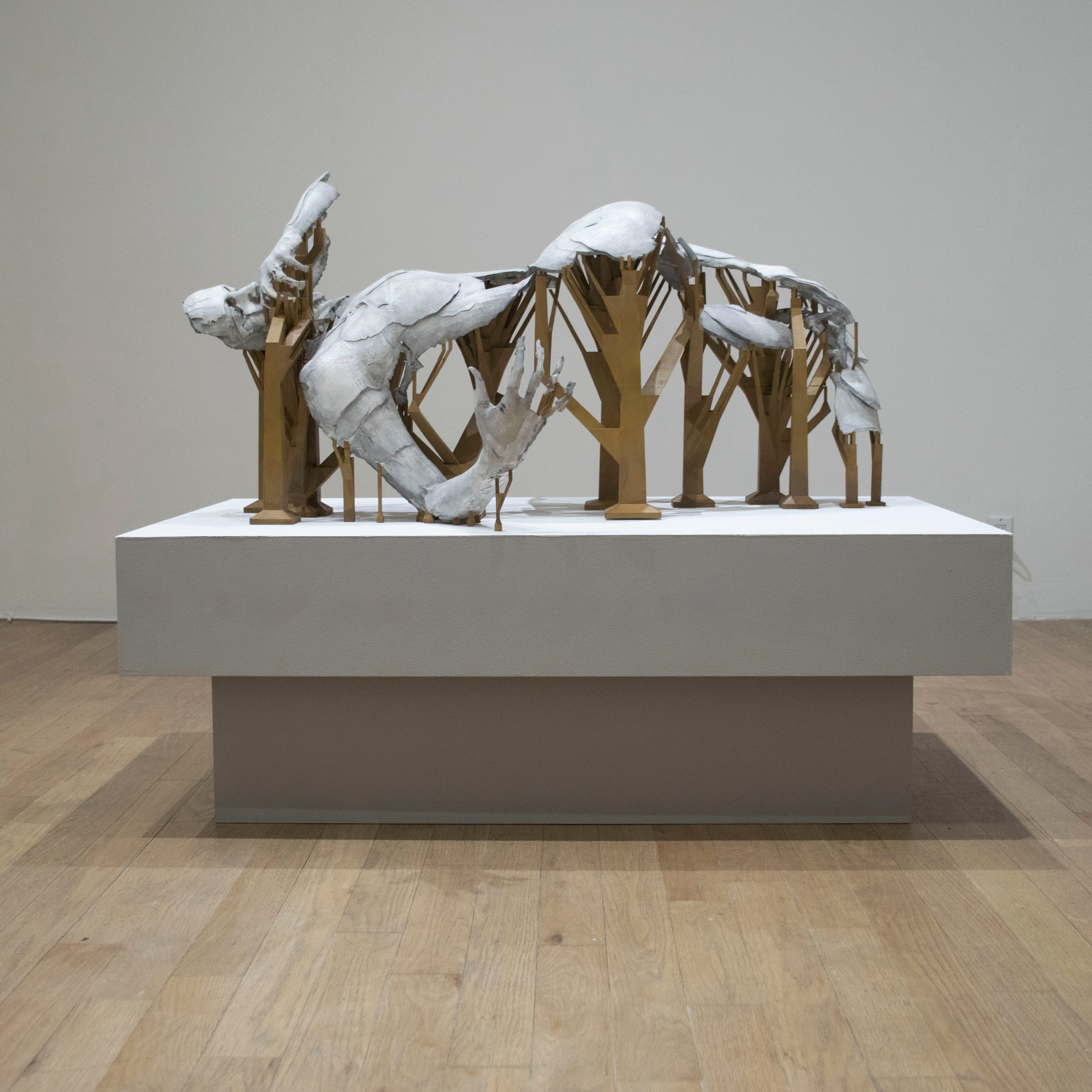
SK: I think I also a coming of age conversation, like when I was a little bit older, I guess coming into undergraduate, maybe just before undergraduate, I was also very aware of feminist critique of the power dynamics of image-making and there’s older bodies of work of mine, like The Machines for Suffering, which was much more about the damage that image-making actually did to the body. That’s based on archival material from the La Pitié-Salpêtrière asylum from 19th century Paris.
There were photographs that supposedly chronicled an attack of hysteria. I had dancers and performers recreate these as incomplete kinds of shadowed bodies. At the time, I was very much thinking of the idea of imaging something and damaging as its capturing and the entire other history of loss and capture that’s associated with photography is very colonial.
Such as the documentation of the disappearing Native American cultures that were made in the 19th century. For example, you’re photographing something to preserve loss, but all you get is the images which are reductive. You know, people’s lives are lost and cultures are lost. And really, what is the image going to save? It’s only really for the edification of the colonizers.
DE: Right, photographing people is inherently a lossy process, even when the priorities of the image-maker are not ill-intentioned, because you’re losing nuance and you’re losing stories and specificity.
As you were speaking, I had this idea: I wonder if you had ever thought about giving your subjects the scanner so that they could scan their own bodies? Or enable them to pursue a personalized way to capture themselves. It might address the challenges we were speaking about earlier, because they’re making the choices of what part of their body is shown, which would also mean that the scan might not be the best scan. Meaning, what’s captured and what’s lost will be different than if you were to scan their body.
SK: It’s worth a shot. You need a certain amount of distance though. I have certainly done my own body and found that the face was really hard. What I wanted to build was a selfie stick for it, because you really need a good three or four feet between the scanner and the subject. I got as far as buying some PVC pipe, and then I got sidetracked, and, like, never did it, but I’m sure that pipe is still in my studio.
DE: You wrote an essay called, On Preserving Glitch for the 3D Additivist Cookbook (2016), about the glitch as something fragile. So I want, especially given the beginning of this conversation with the artifacts of technology not being where your mind is anymore, to circle back to how you feel about the glitch now?
SK: My essay was actually almost a tutorial on, how to replicate my process, which I wanted to put out there to people. It’s one thing that Colette Robbins, my collaborator from File Exchange, and I have also both observed, is that we found that there’s more of a generosity in the particular niche of the art world that we’re in. As you know, the maker community has that generosity as well. Whereas I find, although I don’t want to make generalities, people on this side of the art world are happy to share resources, and they’re not so cagey about things being like a trade secret.
With that said, my workflow is so ridiculous, I can’t imagine that anybody else would ever want to do it. It’s so exhausting. But yeah, that was about how to 3D print raw scanner output without correcting it, which is a lot of the challenge that I have to deal with.
There’s been a lot of really interesting scholarship done around glitch. Obviously, Legacy Russell’s book was great. You know, talking about it as resistance. My ideas are probably pretty much in line with hers, where the body resists representation–it evades capture. The very specific aesthetics of it are maybe less important to me. I think of it more in the context of, again, going back to early art heroes like Francesca Woodman, who had bodies that were disappearing into architecture and blurring. You rarely saw a face that was resolved. The camera was turned on the body, but the body was escaping.
So to go back to the 3D Additivist Cookbook, I have ridiculous workflow where I spend weeks or months dealing with these raw scans in Zbrush and re-sculpting them and adjusting poses and deleting parts where I want to open up the body, or pasting things from other skins. It’s not like a one click and something is done. There’s all kinds of, maybe like collage or pastiche or kind of assemblage that is happening. Then there’s so much more work to make them structurally sound and to exist in this world as a physical object. So between all of that, I would actually love some AI stream monitoring. We’re not there with the 3D in particular, but I’m sure that it’s coming. But there is a visual obsession.
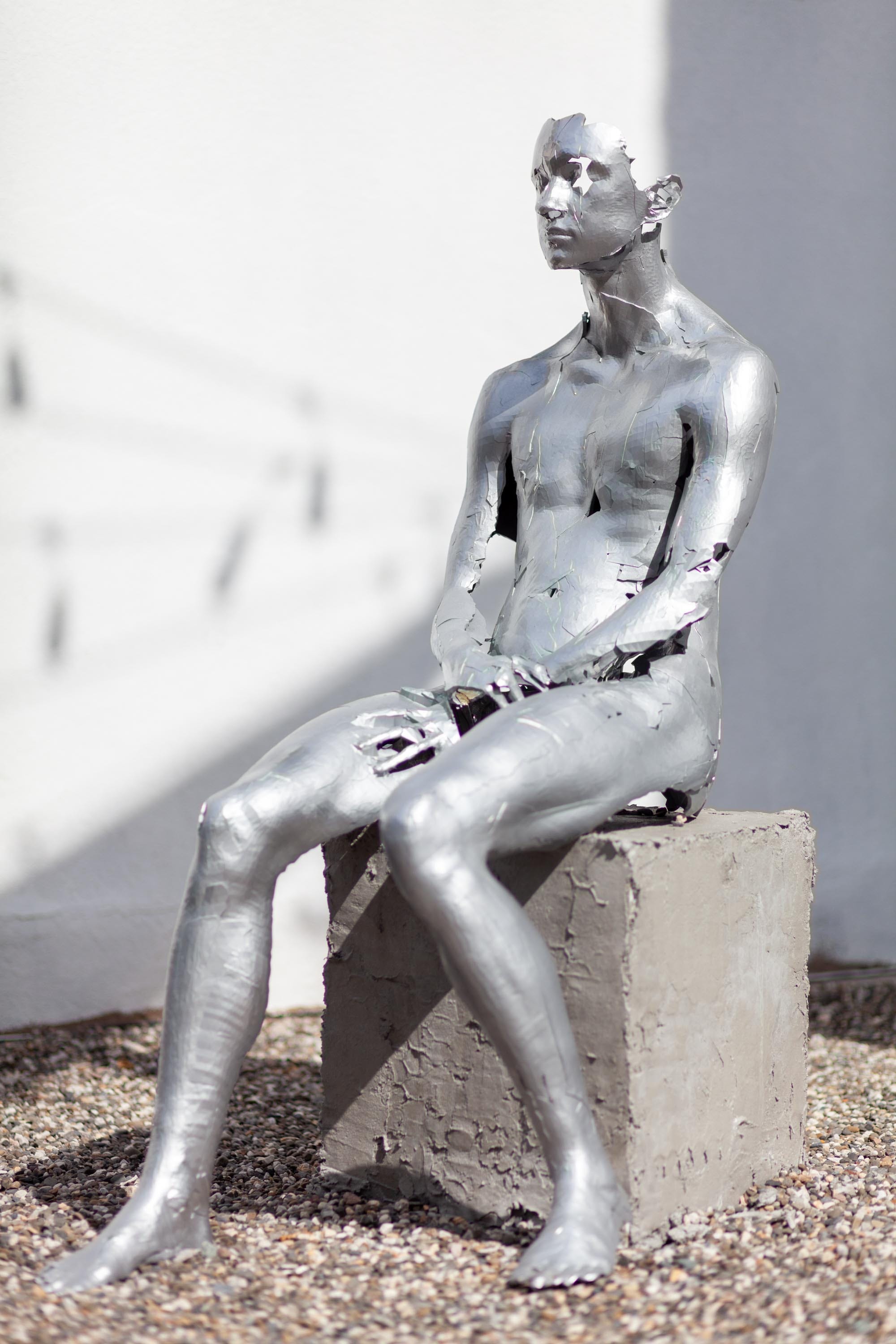
But I guess the glitch is still there for me because I’ve been using this same device so consistently for so long. I’m not married to the specifics of it though. What is important in the aesthetics of my work is the layering and the fact that the person’s body has all these multi levels. I think of the scan layers as overlapping tectonic plates, because every time I point the scanner and click and hold it down and sweep and capture a little part of the body that basically makes one little shell.
Then if they move a little bit, I do it again, then they’re not aligned. If I were trying to do a good scan, which I do in my commercial work, I would run an algorithm that registers and matches all those shapes together and makes one smooth skin and fills in the holes. But I’m in my work, I purposely am not doing that. There are all of these different little moments of capture and moments of visual registration that are happening. And then there’s hundreds of these that all become melded into one object eventually.
DE: You’ve said you think there’s a real danger in becoming too much of an expert with the tools you use and that your best moments as an artist have been when you didn’t know what you were doing. This makes some sense to me, after working in any field or with any process long enough, you develop opinions that not only inform your point of view. And yet, there is magic in the unknown and magic in being a novice at something. Can you walk me through how you crack your process open to make room for discovery?
SK: I think this is doubly important with tools like 3D software where there are narrower tracks for what you can and can’t do, and also in digitally fabricated sculpture where structural stability and engineering narrow the field of what can be made. I’ve never had a painting or drawing practice so I don’t really have a point of comparison, but lateral thinking in very directive tools is always a challenge. I think that there is always a push and pull, I might go into the software with one idea and then the medium provides some resistance, and the results can be dull or they can be really compelling for me. Like photography, it requires an editorial eye more than anything: when I’m scanning a model, too, we’ll choose maybe five poses and within those, I’ll do a number of scans, and then I’ll choose the one that really speaks to me, either in gesture or form or the chain of associations that the image might send me down. There is a really particular state of consciousness that that kind of creative thinking requires, it has to be open to free association, playful, and both focused and unfocused at the same time.
DE: You mentioned earlier running a commercial scanning business. How does economics factor into your practice? What is gained or sacrificed from working the way that you do? How do you think about sustainability within your practice? Meaning, what is required of you to keep making work, and are you at peace with those decisions?
SK: This is a great question, and I don’t have a really great answer. I really enjoy running the business and I meet so many interesting artists this way. I’ve worked on Netflix shows, DC movies, gone behind the scenes at the Museum of Natural History because of my commercial work. There is never a dull moment, and I love that I get to delve into so many worlds of niche expertise, from scanning fencing equipment to using software to calculate the flotation properties of 3D scanned boulders, or analyzing the properties of priceless carved wooden instruments. But it isn’t a stable salary and the overheads are considerable. Between adjunct teaching, consulting, talks and freelance work, it’s a patchwork and it feels like the different pieces never quite cohere.
This is a story for another day, but I’ve just begun a second Masters degree in an entirely different field, with the long term goal of being in the studio a couple of days a week around another flexible job. I don’t have great advice for younger artists but I am always fascinated to hear how each person makes it work and continues to carve out what time and energy they can for their practice.
Nice conversation! I enjoyed reading about how influences and processes stick with us, even when those sources are seemingly “out of date,” like Arbus or older scanning tech.