

The Compressed Space Between Time and Labor
A Conversation with Travis LeRoy Southworth

In this conversation with artist and retoucher Travis LeRoy Southworth, we trace our overlapping paths through the worlds of commercial image production and conceptual art. Both Travis and I share a similar career trajectory including how our careers have informed on our artistic practices, gravitating toward making work about the invisible labor that makes photographs consumer ready, the aesthetics of the early Photoshop era digital images, to NFTs and now generative AI. What unfolds is the kind of a deep dive I love having with fellow artists not just because we share a similar sensibility, but because the conversation gets at what survival looks in a system that asks artists to move faster and produce more to be seen.
D: I became aware of your work through NFTs in 2021-22. Your series Detouched (2005) and Color, Balance (2016-ongoing) explore some of the same concepts in my series The Intentional Object (2013-15) and Phantom Limb (2015-16). I still find it hard to believe that I hadn’t found you sooner given our overlap. I have a background in commercial retouching and I’m wondering if you came to your work from a similar path?
T: Yes, I’m surprised our paths didn’t cross sooner. Mine started in the late 1990s, when I began using Photoshop in my art practice. I was studying photography then and became interested in manipulation of the body. Much of my work in the early days focused more on self-portraiture and metaphysical questions about existence.
Interestingly enough, I was working as an Assistant Registrar in the Richard Avedon Archive at the Center for Creative Photography in Tucson around 2002. I had to inspect giant Avedon portraits for any damage from traveling exhibitions. I had a detailed sheet for each artwork with a list of ‘accretions’ on the print. I would say this and airbrushing physical prints were my first experiences that later influenced my thoughts about retouching, imperfections and digital remnants.
I gained so much experience those early days that I would get hired to help digitize commercial photographers archives and began removing dust from scanned transparencies. These small jobs later lead to commercial retouching for stock photo agencies and later fashion, beauty and major brands.
My first works that probably directly involved retouching as a conceptual area for inquiry was Detouched in 2005. These involved the facial imperfections such as wrinkles, moles, blemishes and stray hairs, that were often cast aside for the creation of “ideal” portraits in advertising.
I still freelance as a senior photo retoucher at one company in NYC. It certainly has helped fund my art practice, as well as, influenced my ideas about art and technology.
D: I like that word accretions, which implies an additive process. There was a very particular moment in time around 2010-15 when photographers were interested in exposing all the mark-making that went into the production and consumption of photographs. In some ways it feels like that moment has decidedly passed, but maybe it’s just changed shape in response to generative AI.
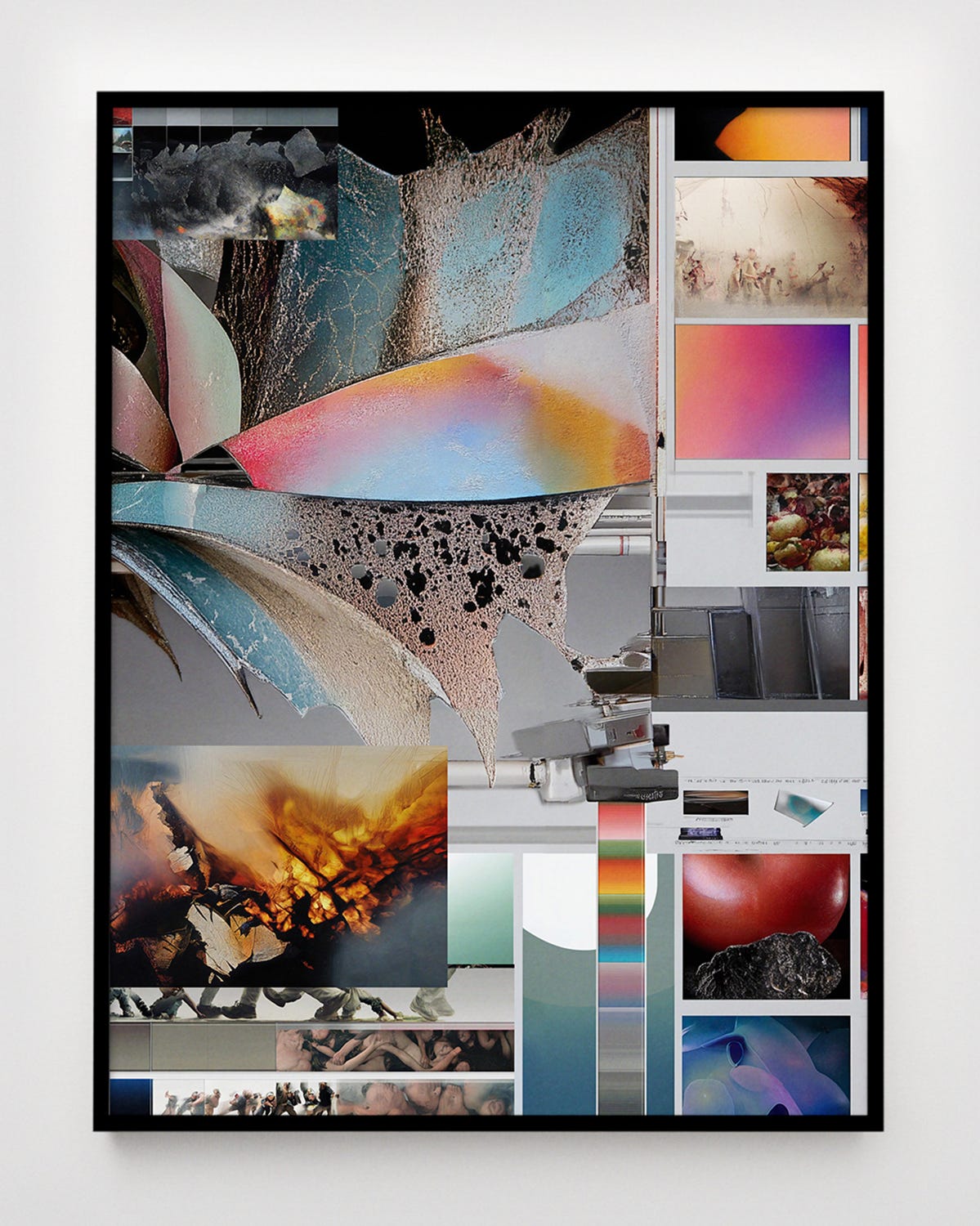
T: I think you are exactly right, there was a good number of photo-based artists exploring similar ideas of labor involving image manipulation back then. It’s funny because I think about that time a lot for a number of reasons. At least for the works I was making, it was a labor intensive practice to secretly “collect” these portrait flaws and render them. Early pieces were rendered with so much precision and as time went on, they became more loose and painterly, playing with quick gestures.
It was in 2013 when I was at an artist residency in Switzerland visiting the Large Hadron Collider at CERN that I began thinking about the applications of AI shifting through massive amounts of data. I actually proposed a grant to a notable art foundation to create a machine system that would ‘collide’ images to create new ones. Sort of a pre-GAN idea. Sadly no one could understand what I was talking about and I sort of gave up on that idea only to discover a number of people made it happen years later.
We don’t talk enough about social media in relation to perception and manipulation. I consider that 2010-15 time frame to be sort of a proto-social media era. It was around but our daily lives didn’t seem surrounded by it as much. I mention that because I feel a lot of generative AI art ties into the pressure to make something quick and flashy. AI in some ways has become the go to for quick manipulation now, often for consumption on Instagram. Both have a certain shared algorithmic intention, I’m oversimplifying here, but I’m interested in this symbiotic relationship. I have a lot to say about AI, but I wonder if you have a similar feeling?
D: I think what interests me about photography to begin with is rarely what is in front of the camera, but the medium’s untapped potential to see beyond the frame. Which is to say, that the camera is used as a vehicle of desire to reach beyond what is seen or known into something else. Clearly, this is not how the camera is generally used, but the invention of the telescope, microscope, or even the emotional impetus behind invention of spirit photography. There’s a transformative process taking place, often emotional, to capture something that is out of reach.
In the early days of generative AI, around the same time that you were at CERN, I was thinking about this idea of emergence. How can an image, with indexical properties, be created out of nothing? It felt like Google Deep Dream, and the psychedelic puppy slug images it created, were the phantasmagoria of that time. Similar to spirit photography there’s a fiction that also emerges alongside generative AI images, even if the data it ingests is made up of photographic images. It’s the fiction that could tell us about those emotional drivers.
It’s interesting that you mention the connection to social media where generative AI really took off, at least in our little corner of the internet on X [Twitter], and was wildly embraced by many of the artists producing NFTs. I believe I started to see a difference in late 2021 that my posts weren’t reaching as many people as they used to. This is noteworthy because unless you were an already established digital artist with a built in platform, the emerging artists trying to get their work seen were fighting the algorithm. This meant you had to flood the system to get any traction, so in many ways, the mass adoption of genAI tools and the pressure for artists to be chronically posting online to be seen seems intrinsically linked.
T: I’m curious how your work has developed since Phantom Limb and The Intentional Object?
D: I still really love that work because it boils down a few core themes in my practices that I continue to come back to regardless of what technology I’m working with and that goes back to that idea of the unseen and the transformation process that I mentioned earlier.
Right now, I’m collaborating with the author Marin Sardy on a long form series, Psychic Telephone (2024-ongoing), where she’s interviewed people who’ve had psychic experiences and I use those transcripts to feed into a generative AI system. But instead of having the synthetic image that it produces be the final artwork, I use that as an icebreaker in the studio to create photographic, camera-born images. The final selection of work is photographic (albeit manipulated either through traditional studio means or digitally) and her text. So in some ways, I’m still grappling with those core themes.
What comes up from me in the process, and you’ve touched on this, is the economic drivers under social media, NFTs, and how artists, whether consciously or unconsciously, are shaped by what I can only describe as an increasingly dire economic landscape, at least in the United States. For the record, I call out the U.S. specifically because much of the funding landscape is privatized here and so support for a creative practice looks very different here than in other countries, which I think makes American artists industrious in a very particular way, for better or worse. As someone whose commercial work is in dialog with your artistic practice I suspect you have some insight into these pressures.
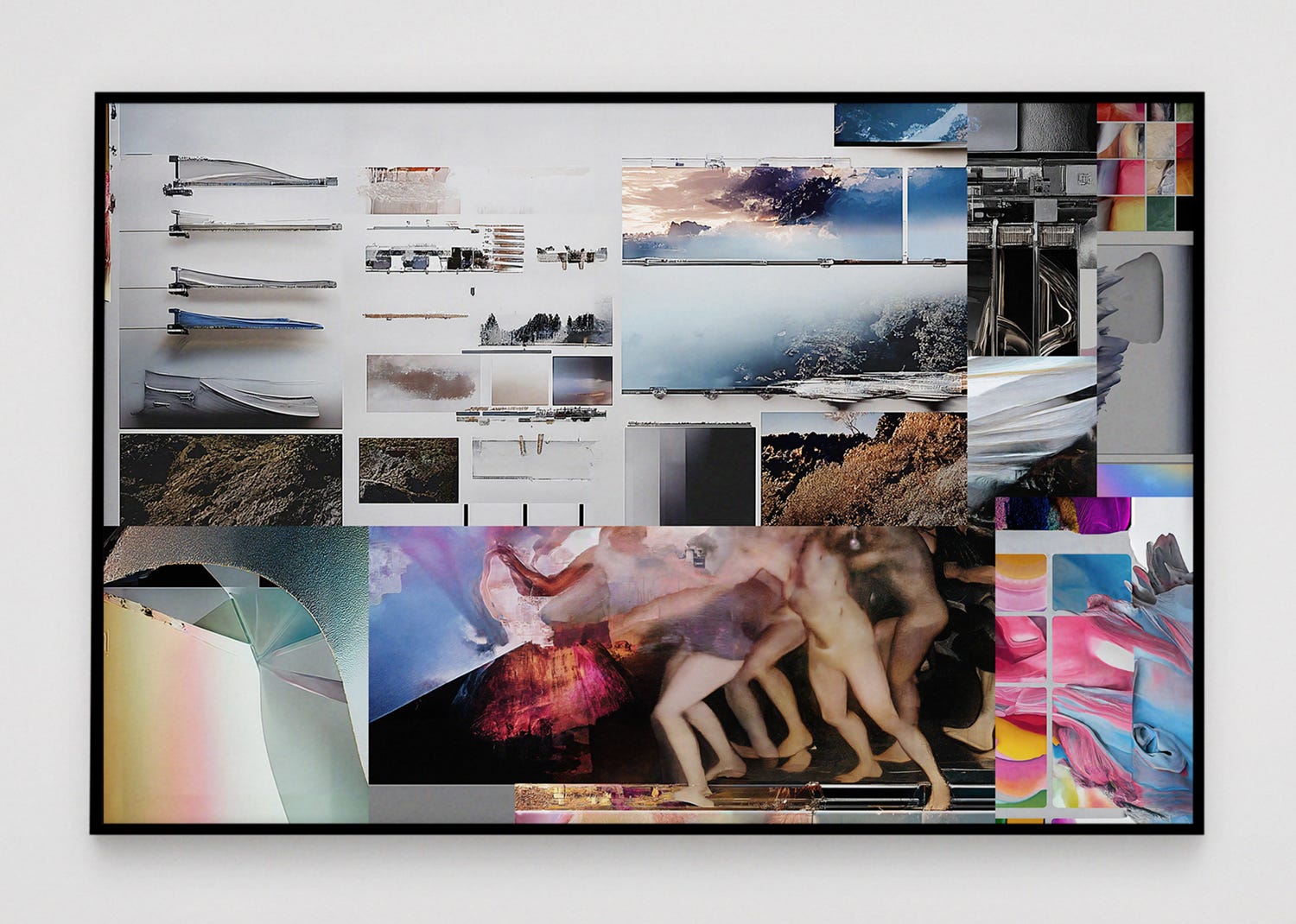
T: Yes, I think artists have been grappling with this more than ever, the rising cost of living paired with the accelerating pressure to succeed in the eyes of an algorithm. It’s a peculiar double-edged sword. I’ve felt that tension for most of my career: the duality of working in a commercial image economy while trying to carve out space for slower, stranger investigations. The two worlds bleed into each other in ways I can’t always untangle, and I’ve often leaned into that friction as material for my work.
My commercial experience has given me a front-row seat to how images are shaped by market demands, especially in the creation of idealized portraits. It’s also made me acutely aware of how relentless and extractive those demands can be. Growing up in a working-class family, I knew early on I’d need steady work to sustain my practice. That background instilled a respect for labor, whether manual or digital, not just as a means of survival but as an ethic, an invisible architecture holding everything up.
This thread became central in my series The Continuous Work Drawings (2012), 1,500 digital drawings I made while retouching e-commerce images at my day job. The project treated accumulated labor as both a physical and conceptual material, and I’ve carried that sensibility into everything since.
In the NFT moment, and now in the AI moment, I see echoes of the same machinery: the push to produce constantly, to perform visibility, to turn every gesture into content. Time and labor are compressed, with work that once took days or weeks now expected in minutes, not for deeper artistic reasons, but to satisfy an algorithm indifferent to care. Even when I’m critiquing these systems, that devotion to the unseen hours of work is still there, quietly shaping the image.
You’ve mentioned the transformative and unseen as core themes, how do you see those ideas holding up in a moment when visibility (especially online) is often tied to value? I’m curious if we are entering a new era, where it is becoming more important to be seen.
D: Being seen online is not new, however, I think more people are recognizing the very real world pitfalls of being and producing work online–how the politics of visibility are not only tied up in economics of their livelihoods (whether we, as artists, chose to participate in social media to drive attention to our work), but also what’s actually at stake when you put yourself “out there”. But more broadly, centralizing platforms like Instagram and Facebook extract our data as citizen-users and use it to profit and in many cases can use it against us. At this specific moment in time, I think many people are contending with that economic imperative of being seen online but also negotiating how creative or political expression in the public eye now also can mean a negotiation of safety. Or even that politics of being online and creativity are explicitly tied more than we were willing to admit, compared to say 10-15 years ago.
I know for myself, I have been thinking less about fighting the algorithm to drive traffic and more about what’s lost or gained in participating in a system that doesn’t have my best interests or even end goals in mind. What does an artistic practice look like if old models don’t work anymore? What is required of me to lead the kind of sustainable practice that I see for myself if I don’t want to subscribe entirely to the prerequisites of being chronically seen in that way?
I struggle with the increasing financialization of art-making—art objects as assets out in the world—and coming from, as you say, a working class background where labor is and someone who labors is not only required, but valorized. Which is all wrapped up in this country's founding principles and the American Dream. I’m trying to detangle, for myself, this particular moment or new era, if that is in fact what we should call it, that working more doesn’t necessarily have anything to do with being able to support yourself as a creative person, that being prolific (i.e. keeping up with the demands of posting or showing up online) does not equate to intellectual, cultural, or canonical value, and how the need to support myself and to produce something of value outside of an economic system also means rethinking modes of curation and distribution. Which is a long-winded way of saying that more than ever there should be non-profit institutions and alternative frameworks for supporting what we artists do. The stakes feel higher don’t they? What are you doing for yourself to make the kind of ecosystem that is more humane for your practice?
T: Yes, the stakes do feel higher. Maybe that’s because the ecosystem around art-making feels more precarious and bigger than it did even a decade or two ago. I was speaking with someone recently about something called The Art Diary, like an art book of the early 2000’s in NYC if I remember correctly. And everyone you needed to know was in there. It sounds like such a simpler time in retrospect. You just needed one resource. I think about this a lot in terms of energy management: how much of myself I want to invest in systems that are fundamentally extractive, and how much I can redirect toward slower, more intentional spaces where the work can breathe.
For me, part of creating a more humane ecosystem has been building parallel tracks. I keep my commercial retouching work, which gives me financial stability, but I’ve also carved out pockets of time that are deliberately shielded from the speed and noise of the algorithm. I treat those pockets almost like protected habitats, places where the work can develop without the pressure.
I’ve been leaning more on direct connections with other artists, as a means to slower channels. I’m interested in frameworks that feel more like communities of practice than markets. Though to be honest I often feel it is everyone for themself. I do miss dialogues about value, labor, and long-term engagement rather than constant output. It’s not perfect, and it requires ongoing negotiation with the economic realities we’re both talking about, but it does keep me tethered to the reasons I wanted to make art in the first place.
Sometimes I think of it in terms of conservation, kind of like preserving a species from extinction. The conditions outside might be hostile, but you create micro climates where your work, and your way of working, can actually survive.
Your description of Psychic Telephone really struck me, the way you’re using generative AI not as the end point, but as a kind of intermediary in the studio, almost like a séance with a machine. For this work it feels like the synthetic image is just one participant in a larger exchange between language, memory, and photographic vision.
It makes me wonder about the economics around these tools more broadly. Generative AI is often framed as “democratizing” image-making, yet it also shifts value away from sustained labor toward instant production—and in doing so, maybe changes the kind of belief or care we invest in an image. Do you think the speed and abundance of AI-generated imagery alters the way audiences assign value or trust to a work, especially when that work engages with the unseen or the speculative?
D: Digital photography democratized chemical photography. Camera phones democratized digital photography further. I think this word democratizing is more complex than it leads on. On one hand, when tools become easy to use more people use them. With that, there’s a higher potential for people to make cool things with those tools. If we just consider that idea that—more is more. More people doing something doesn't intrinsically devalue that thing unless you subscribe to a scarcity mindset. Where certain things are only valuable if they’re rare. This is, as far as I can see it, how capitalism works and therefore how the art market works. If we follow that logic, then it makes sense that photography has always been undervalued monetarily compared to painting. If we take it further, then, sure, AI-generated or synthetic images perhaps have less value than photographs, have less value than painting and so on. It feels in line with Benjamin’s In The Age of Mechanical Reproduction.
But if we sit with this idea long enough we realize that this is not the only way that value is made, and even this idea of scarcity is something to be suspicious of. Is it possible to have an artwork where more is more, and value is assigned not in contrast to how rare it is, but in relationship to other characteristics, and what are those characteristics?
There are some bright minds talking about the value of digital art right now and how value is assigned to objects or experiences in an art economy. I mention digital art only because if we believe that the infinitely reproducible holds little to no value then digital art is worthless. In part, this is what the blockchain is attempting to do by distinguishing a signed original versus a copy. But it still, as I see, functions mostly within the context of scarcity and I wonder if that’s the point we’re all missing.
Trust in synthetic images is another matter entirely. As retouchers being on the inside of a system that manipulates images to intentionally change consumer’s behavior, I think we both have a lot to say about that. There are some obvious, well-trodden conversation points about truth and trust in photography for its indexical potential. But part of me, perhaps because I like playing devil’s advocate, wonders if there’s another conversation to be had. Datasets are archives, if we are very intentional with what images go into our datasets, can the images produced by generative AI be a form of truth? Truth adjacent? I’m thinking of that famous Albert Camus, “Fiction is the lie through which we tell the truth.” What do you think about this?
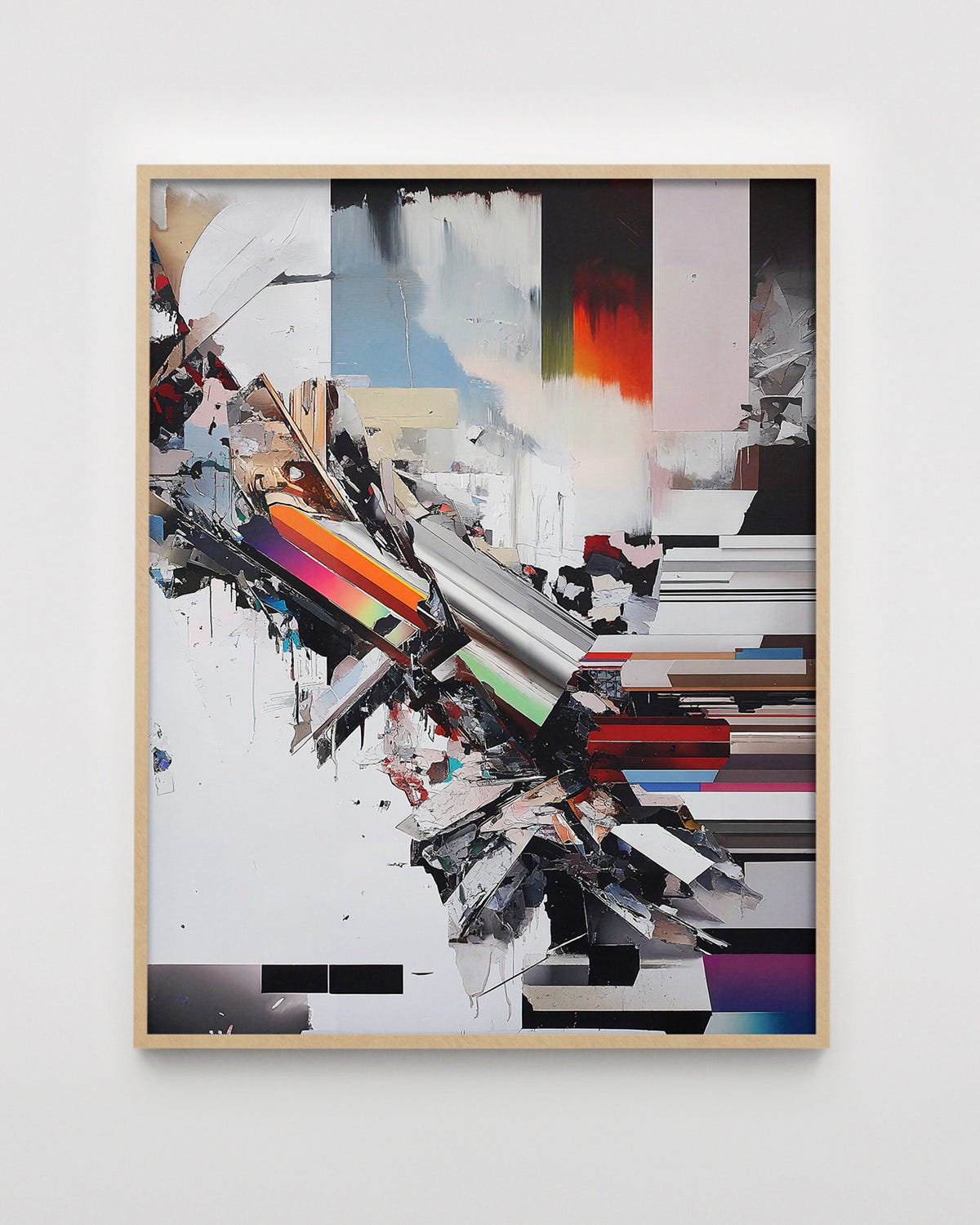
T: I’ve always been fascinated by that tension, that an image or idea can be a fabrication and still reveal something deeper about reality. Working as a retoucher made that contradiction very real for me. In a commercial context, the manipulation is designed to create a fiction that serves a market: an idealized portrait, a perfected surface. But in an artistic context, manipulation can function almost like a magnifying glass. For example distorting the literal image in order to expose a different kind of truth, one that isn’t tethered to indexical accuracy.
If we think about datasets as archives, then the act of curating them becomes not just technical, but deeply ethical and conceptual. I really hope there is some whistle blower moment and the AI archives of say Meta, Midjourney or OpenAI are revealed and we can see what everything was trained on.
It’s like assembling a lens through which the AI will “see” the world and what it produces will carry the fingerprints of those choices. I’m drawn to the idea that truth, in this sense, isn’t an inherent property of the image but an emergent one, shaped by intention, context, and even constraint.
Scarcity has always been a strange metric for art, especially in the digital space. My own work has often been more about accumulation than rarity. Sort of like the slow build of gestures, the labor embedded in repetition. I think there’s a possibility for value to come from density, from layers of intention and meaning, rather than from the fact that something is one-of-a-kind. “More is more” can be its own kind of scarcity, if the “more” is specific, deliberate, and deeply informed.
So maybe the question isn’t whether synthetic images can tell the truth, but whether we’re willing to see truth as something that can emerge from a constructed system—the way a photograph taken with a microscope tells us something real, even though it relies on a tool that fundamentally alters what’s visible.
I do want to say something about blockchain, I think of it less as scarcity, and more as provable ownership of digital objects. Images can still be shared and proliferated, often it is preferred. But now at least if a digital artwork has been tied in some way to a blockchain by an artist: there is a provenance, a timestamp, a public record of its origin. In that sense, the blockchain isn’t a guarantee of artistic value, but it does introduce a verifiable layer of the object’s existence in history. It actually might be the closest thing we have to an “aura” for digital works.