

On Broken Ground
A Conversation with Hannah Smith Allen

Hannah Smith Allen works across photography, printmaking, book arts, and moving images to investigate how American history and lore shape the country’s physical and political landscape. Her current exhibition, On Broken Ground at BAXTER ST at the Camera Club of New York, gathers nearly a decade of work made along the U.S.-Mexico border, including still photographs, unique screen prints, collages, the Dream States video installation, and her limited-edition artist book Borderlands (VSW Press, 2021). Allen is the 2025 BAXTER ST Mid-Career Artist Fellowship recipient and an Associate Professor of Photography and Digital Media at Adelphi University.
In our conversation, we discuss what it means to build a body of work based on the fluctuating boundaries of physical and virtual landscapes, the move away from the singular photograph toward fractured and malleable image systems, and what self-censorship looks like for an educator working with politically charged material.
DE: Last week, I had the pleasure of meeting you in person at BAXTER ST to walk through your show, On Broken Ground. Can you give me a high-level view of what this series is about and how it began for you?
HSA: My border project began when Trump was first elected President in 2016. Throughout his initial campaign, he promised to expand the border wall between the U.S. and Mexico. This promise was more than just a policy proposal; it became a symbol for a new vision of America, one that aggressively asserted independence from the world while simultaneously ignoring its traumas. As an artist deeply engaged with the landscape as a political site, I knew I wanted to explore the U.S. southern border firsthand in order to understand the magnitude of Trump’s vision.
Initially, I examined the wall through Google Earth, clicking through cities like Calexico, California, and Nogales, Arizona. Eventually, I noticed that at certain points along the border wall, I could click through the wall into Mexico. These unmarked crossings created a strange sensation. Even though huge swaths of the American landscape remain undocumented by Google, the platform still faithfully replicates physical space; impassable structures in “real life” generally remain impassable online. Yet here, in Google’s version of Calexico, I managed to click through the wall and land in Mexico. Further still, as I clicked through the wall, the image lag and loading system resembled a mirage of the wall disintegrating and crumbling. For me, these images became not only a vision of how our border could operate, but also a symbol for the fragility of the nation itself.
At first, I believed these secret crossings were glitches within Google’s system. Over time, however, I came to understand that Google’s navigation does not truly recognize borders. If an adjacent Mexican road runs parallel to a U.S. road, users can click through the wall regardless of its physical impassability. This discovery felt especially significant in light of the 2017 ruling that Trump’s tweets constituted official presidential statements. At that moment, it seemed like we were fundamentally redefining the relationship between politics and technology.
When I discovered these “glitches,” or “digital crossings,” my first impulse was to make screen recordings of my Google travels. While the recordings documented the crossings successfully, the videos themselves were slow and lagging. I eventually decided to take screenshots from the recordings and reproduce the glitches as still images. My next impulse was to visit the border itself in order to encounter the wall in physical space.
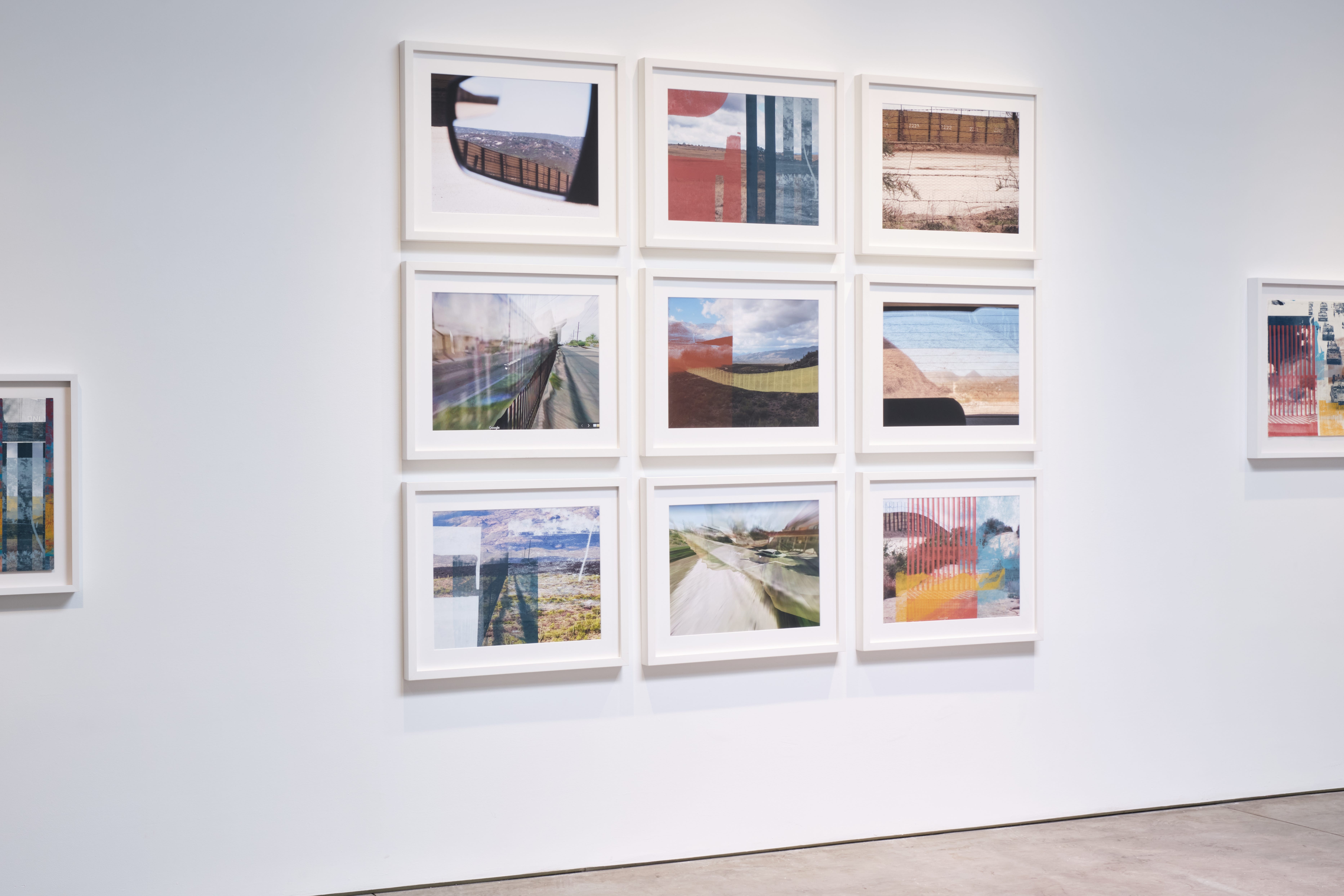
I made three trips to the border before COVID halted most travel. I first approached the wall in Jacumba Hot Springs, California. I pulled my rental car onto the dirt road adjacent to the wall. The dry heat, dust, and silence of the landscape became palpable. Less than five minutes after I parked, a Border Patrol vehicle drove down from a makeshift carport at the peak of a nearby hill to question me. After speaking briefly with the agent, I began photographing the wall structure. There was a profound dissonance between the apparent solitude of the desert landscape and the persistent state of surveillance surrounding it.
Through these physical travels, I learned that the border extends far beyond the wall itself. Border Patrol agents monitor land well beyond the wall’s physical boundary. We often discuss privacy in digital spaces, but virtual surveillance is largely silent and invisible. In the physical landscape, surveillance becomes visible and symbolic of power. I am interested in the differences between the virtual and the physical: what does it mean to live simultaneously within these two realities, and how do these overlapping realities shape image-making?
In many ways, this project, and the exhibition as a whole, wrestles with the tension between physical form and the intangible digital image. Today, it is increasingly difficult to locate the “real,” both in politics and in photography. The collages and screen prints featured in the exhibition assert the hand and physical presence of the artist, while the video installation confronts the instability and intangibility of the digital image. I would argue that both of these visions of America are simultaneously real and present.
DE: I’m curious what it’s been like to build a body of work that depends on a system’s bugs. Ten years in, are the glitches still there? Has Google’s rendering gotten more seamless, harder to exploit? And how has that shaped where the work has gone since then?
HSA: Surprisingly, Google Earth’s version of the southern U.S. border does not seem to have changed significantly over the last ten years. Much of the border region remains undocumented. I imagine this is partly because so much of the terrain is remote; in many places, a single dirt road parallels the wall, and where no wall exists, the landscape is largely wild and inaccessible. Of course, there are also sections of border country controlled by the government that remain off-limits to Google.
My initial screen recordings were purely documentary, and the screenshots emerged almost as an afterthought. It would have been nearly impossible to capture still images directly from Google Earth in real time.
In 2025, I created the first iteration of my video piece Dream States for an exhibition at Middlebury College in Vermont. When I returned to the Google border in 2025, much of the landscape looked and functioned similarly to how I remembered it. This time, however, I shot video, took hundreds of screenshots, and then used stop-motion animation techniques to create more seamless videos with greater control over timing and image sequencing.
For me, what changed over the last ten years was less about Google’s technology and more about how I came to understand these “digital crossings.” They evolved into broader symbols of immigration, border politics, and the instability of the American landscape itself. Trump’s presidency made me question the very idea of America and how that idea shifts depending on who is imagining it. These hallucinatory visions of the deteriorating border, and their lack of physical solidity, seem to embody the fragility and abstraction of the American idea itself.
DE: It’s interesting that at first you believed the crossings were glitches, but over time you understood that Google’s navigation simply does not recognize borders. That reframe feels important because it changes what the work is pointing at. A glitch is a failure, an artifact that the system didn’t intend for. But if the crossing is the platform working exactly as designed, then the borderlessness was always there, indifferent to the wall. I’m curious how that realization sat with you. Did it change how you felt about the images you’d already made? And is there something uncomfortable about the fact that the most hopeful image in the project, the wall coming apart, comes from a corporate platform’s indifference rather than from any act of resistance?
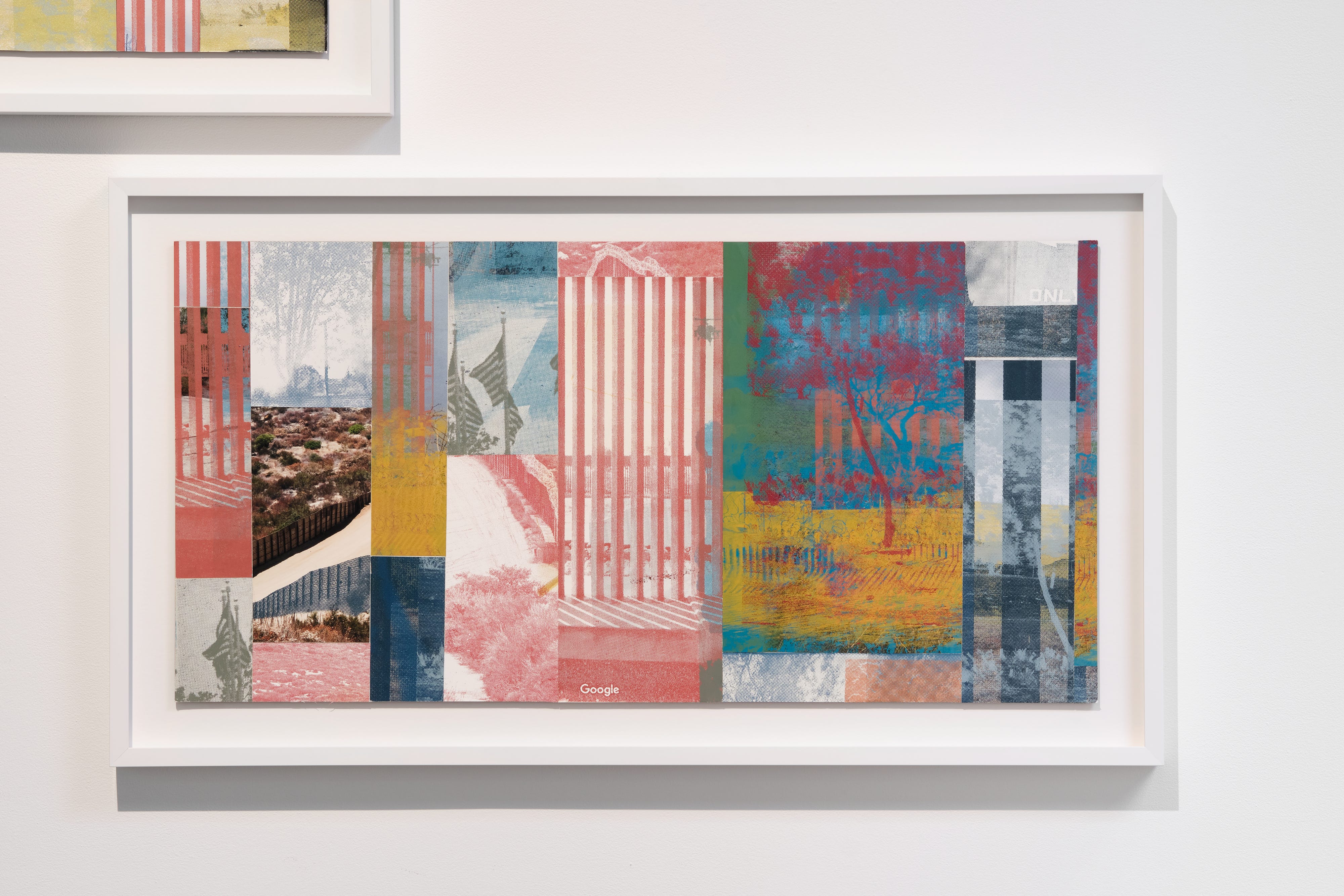
HSA: First, I want to acknowledge this work on a visual level. I am interested in making beautiful images. The landscapes featured in this exhibition may not conform to traditional photographic landscape aesthetics; after all, they depict shallow spaces that are obstructed and obscured. Nevertheless, my aesthetic is informed by modernism and its formal ideas about beauty. The beauty I try to bring into this work reflects the beauty I experience in the American desert itself. Ultimately, I find this beauty hopeful. It points to the enduring power of the landscape and to the promise of the American idea.
Second, I offer these videos of the breaking wall as symbolic gestures. I hope they suggest new paradigms and possibilities. Perhaps the very act of reproducing and transforming the original Google images can itself be understood as an act of resistance. But it is my act of resistance; it is certainly not Google’s. On a visual level, I hope viewers find these moments of rupture compelling, limitless, and liberating. I hope they find meaning in watching the steel warp and yield into abstract fields of structure.
I also want to clarify the distinction between the glitch and the intentional crossing. To be clear, I do not know Google’s intention. The phenomenon of clicking through walls may be a glitch, or merely a byproduct of the programming code. But to me, a glitch suggests a momentary and accidental failure. In contrast, these Google ruptures appear systemic and consistent. In other words, whenever two roads align within the system, users are able to click from one side to the other, regardless of the wall.
The crossing, then, is not simply an error; rather, it reveals something embedded within the structure of the system itself. Google might describe this as a flaw, but I see it as a portal into a different way of seeing and experiencing the American landscape. My act of resistance, therefore, lies in reproducing Google’s visuals, photographing them in order to preserve them as suspended moments within a borderless order. It is important to me that these visions of crumbling walls are understood not merely as failures but as inherent byproducts of the systems we create. In that sense, they carry a certain hopefulness: they suggest the possibility of rupture even within the most brutal systems.
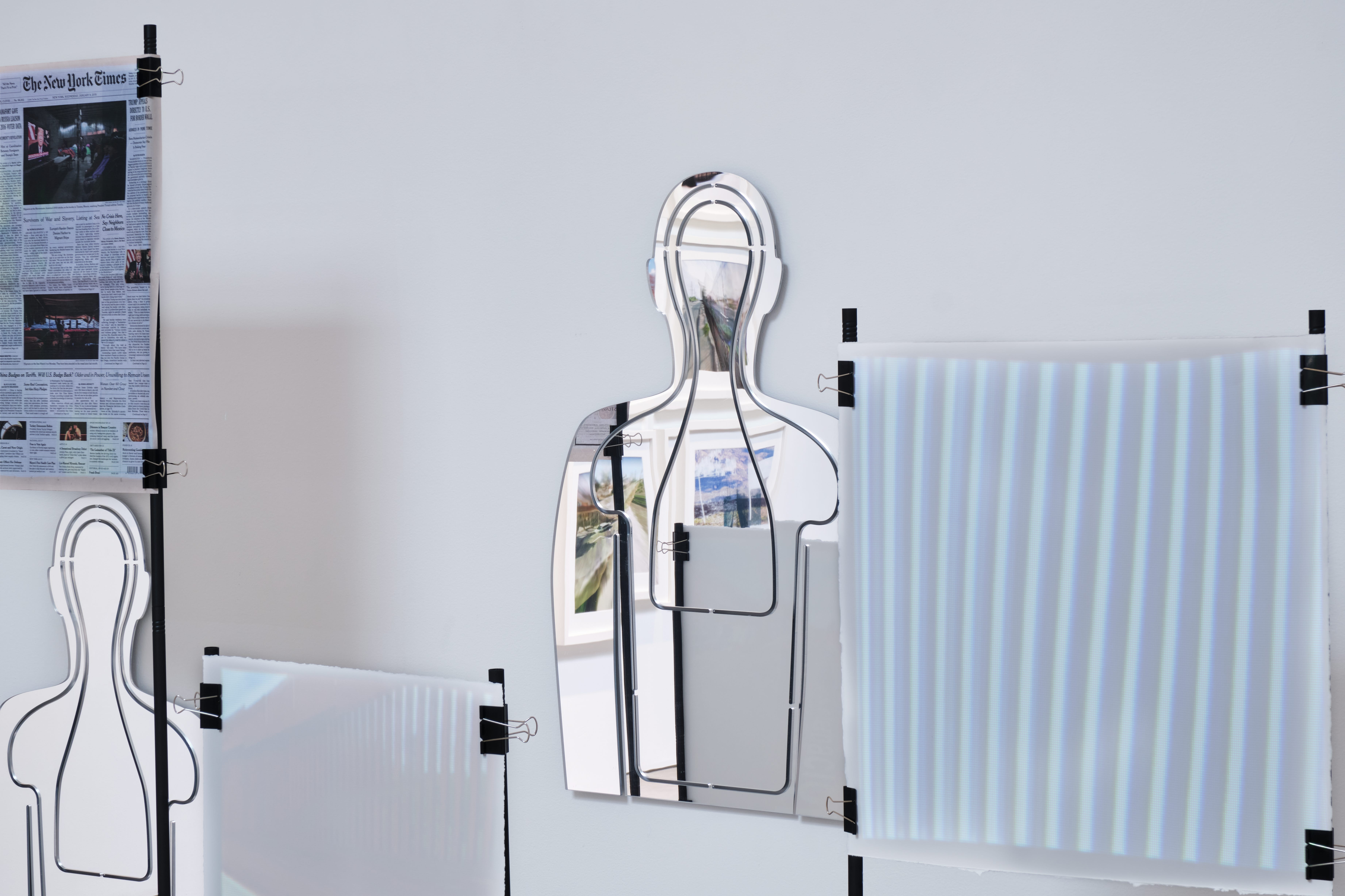
DE: The show layers material made during the first Trump administration with new work that brings in the 250th Anniversary military parade, and the new iteration of Dream States projects onto target stands and newspaper clippings rather than directly onto a wall. That feels like a real formal shift. I’d like to know what changed in your thinking that led to those installation decisions. And more broadly, what is it like to return to this material now, when the stakes around the border have escalated? Does the work have to do something different in this moment?
HSA: In 2020, COVID shut down much of the country at the same time that I was awarded a residency with the Visual Studies Workshop in Rochester, New York, to turn my border work into a book. In March, after the shutdown became official, we decided to transform the award into a remote publishing residency. I worked with Tate Shaw, the former director of the Visual Studies Workshop and Press, for nearly a year to design and publish Borderlands, a limited-edition book and sculptural object. Once the book was released and COVID restrictions lifted, I began focusing on other projects.
Then, in 2024, a friend and contact from Middlebury College asked if I would be interested in exhibiting the border work again. At that point, I knew the project had to continue growing in order to respond to the current political moment. In March 2025, I installed the exhibition Beyond Walls at Middlebury’s Johnson Gallery. For that show, I created the first iteration of Dream States, which consisted of a single-loop video projected onto a barrier structure reminiscent of a wall.
Trump was elected again in 2024, and by the time he resumed office in January 2025, the political landscape was shifting rapidly. When I learned about the BAXTER ST exhibition that spring, I knew the installation would need to respond, at least in part, to the urgency of the present moment. I did not want the work to feel historical or closed off from contemporary reality. In 2025 and 2026 I made a series of collages and screenprints, and I reimagined the Dream States installation.
There is a strong physicality in the earlier work. I always imagined the book itself functioning as a sculptural object, and many of the original photographs are integrated with screen prints and tactile materials. The newer work, however, feels even more tactile. What strikes me most is how far I have moved away from photography as a singular image form. Photography still exists within the work, and the photographic image remains integral to the project both formally and conceptually, but the newest iteration of Dream States, along with the recent collages and screen prints, pushes further toward an understanding of the image as something malleable, fractured, and in motion.
The image has become embedded within the fabric of the artworks themselves. It is no longer centralized, but it remains essential.
DE: I want to slow down on this idea of moving away from photography as a singular image form for a second. What is the photograph able to do now that it couldn’t do when it was the whole frame? And does decentralizing it feel like a loss of something, or more like the image finally being put in its proper place among the screen prints, the paper, the projection?
HSA: I think the single image still has its place, especially as an art form. Those who are able to capture the fullness and complexity of life within a single image are truly remarkable. But within today’s constantly updated photostreams, we are more often confronted with multiple images of the same subject, and we are forced to understand the reality of an idea through an amalgamation of these repeated and overlapping views.
I believe both of these image systems possess poetic potential. When meaning can be contained within a single image, the world seems to point toward a kind of magical order. But when we are forced to reconcile meaning through a shifting array of images, we begin to feel the potential for invention and reinvention. That potential for reinvention is central to my work, and it relates directly to its underlying sense of hope, despite the visible violence.
DE: I talk a lot about the idea of risk here, which can mean different things depending on who I speak with. In the case of your work, this is especially true. There’s a more evident relationship to what’s at stake for you as a photographer in documenting the wall, traveling to it, and encountering border control. Can you speak to what the word risk means to you specifically?
HSA: There is certainly risk in visiting these landscapes and encountering border patrol. I have been followed and questioned more than once. And now, after the visible violence in Minnesota, photographing the border gives me pause. Yet in past situations, I have always been aware of my own agency and privilege. Throughout this project, I have determined when and where I photograph, not a publisher or an agent. Further still, I am white and female-presenting. I imagine a person’s visible identity would deeply influence their experience at the border. This is, of course, true everywhere, but at the border these dynamics are heightened.
In the landscape, curiosity is what drives me. For me, the risk comes from interpreting and representing that landscape. There is something inherently risky about holding a narrative that belongs to 349 million other people. My work is intended as a dialogue, but intention and reception are not always aligned.
DE: Last year, I wrote a piece for the British Journal of Photography about trans photographers in the U.S. and the conditions they’re working under as federal arts funding contracts and institutions quietly self-censor in anticipation of backlash. Leah DeVun called it “anticipatory obedience.” One thing that struck me, reporting it was how many of the strategies the photographers were turning toward, smaller venues, print over platform, mutual aid, in-person rather than online, were also strategies of refusal: choosing what kind of visibility is actually safe. I want to ask if any of that resonates with your situation, even though your work occupies a different political territory. Has this shift changed what institutions are willing to show in your project? Have you encountered hesitation, explicit or implied?
HSA: The art world is not transparent. It is often unclear why certain projects advance while others go unnoticed. Timing, risk, invention, aesthetics, and style all contribute to visibility, but it is difficult to separate and define these concepts individually. I feel that I have cultivated a small, established, and faithful audience for my work, though it has always been a challenge for me to reach wider audiences.
I do think it can feel risky for institutions that want to engage broad audiences to show work that confronts current politics. Today, we are accustomed to retreating into our safe corners of the internet — Heather Cox Richardson on the left and Josh Rogin on the right — to receive affirmation as much as information. But I initially made this work because I wanted to better understand Trump’s vision, regardless of my own political leanings. I believe that if we are going to grow as a country and move beyond this current moment in history, we have to remain curious: curious about one another, about the American experience, and about the land itself.
DE: As an educator, you’re navigating a pretty strange period for photography pedagogy. Not just with generative AI and the affiliated technological shifts, but also the political volatility that higher education is going through currently. Has this affected you, and in what regard?
HSA: I think about these changes constantly. We are living in an era in which everything becomes monetized. What is my future in media, design, or photography? How financially sustainable are these skills? Why learn Adobe if it may be replaced in five years? What is the value of a college degree?
In part, this kind of thinking makes sense in a world where colleges and universities carry outsized price tags and the cost of living continues to climb. But I believe that investing in learning is also an investment in community and in our ability to think critically, adapt, and imagine new possibilities. To me, it is clear that educators are not the problem. Rather, the problem is the capitalist system that has overtaken the university. It is a system within which we are all (students, faculty, parents, and administrators) desperately trying to navigate. I think people on both the left and the right would agree that this system is broken. The problem arises when we point fingers at one another over who is responsible instead of working together to reimagine it, preserve jobs, and create spaces where people can collectively think through ideas.
I have definitely censored myself in the classroom. Beyond teaching my students specific technological skills, I also try to teach them how to read and interpret images; this kind of visual literacy can often feel like a political act. Discussions of images frequently extend beyond formal analysis and lead to conversations about lived experience. Today, this type of discussion might itself be considered political.
Despite AI, I still believe in the durability of the image. Even if the form and techniques of the medium change, photography, as a mechanical reflection of the world, will endure; with it, the history of photography will continue to inform each new process. These kinds of transformations have been constant since photography’s inception. As the medium evolves, our understanding of the “photograph” deepens. Ultimately, this is one of the things I value most about working with photography. In the end, I believe the image is fundamental both to art-making and to our understanding of ourselves.