

A Definitive Yet Precarious Yes
A Conversation with Laura Splan

Laura Splan is one of those artists whose practice seems to exist in permanent yet productive contradiction: a transdisciplinary artist that translates the invisible substrates of biological life into sensory, touchable, sometimes unsettling forms, from computer-embroidered lace viruses, weavings derived from biometric data, and immersive encounters with molecular simulations. The work insists that the complexity of the biological world can be felt and experienced, even before it is fully understood.
In this conversation, we discuss the feminist labor history encoded in craft traditions, what it means to collaborate with scientists while thinking through the role of the artist, and how she’s built a practice that sustains itself through a diversity of relations and engagements.
DE: I don’t remember how we met. Do you?
LS: Yes! I think I remember. We met at a LISA (Leaders in Software and Art) event where you and Anton Marini gave a great presentation on your The Two Body Problem project. I later included it in the Future Artifact exhibition I curated in conjunction with Creative Tech Week. I was interested in your explorations of how technology both facilitates and mediates human connection and have enjoyed our conversations about that ever since, especially as it relates to emerging fields like NFT’s and AI.
DE: Right! What I do remember is being initially taken by your Doilies series, and the haptic and physical nature that much of your work takes on. Over the years, your practice and the methods of engagement have evolved, though, so I would love for you to describe your process, its themes, and then your relationship with the haptic, assuming it’s still relevant.
LS: Conceptually, my practice has always been an exploration of the intersections of science and culture and how the two converge and influence one another. My work often creates situations where sensations are intuitively embodied by engaging multiple senses, including touch or tactility. Like how an intricate data-driven drawing made from electromyography measurements of squinting can elicit a squinting gesture in the viewer. I often look for either Rube Goldberg, or recursive potential in how viewers experience an artwork, and find that simple haptic responsiveness can function as a trigger for a more elaborate unfolding narrative.
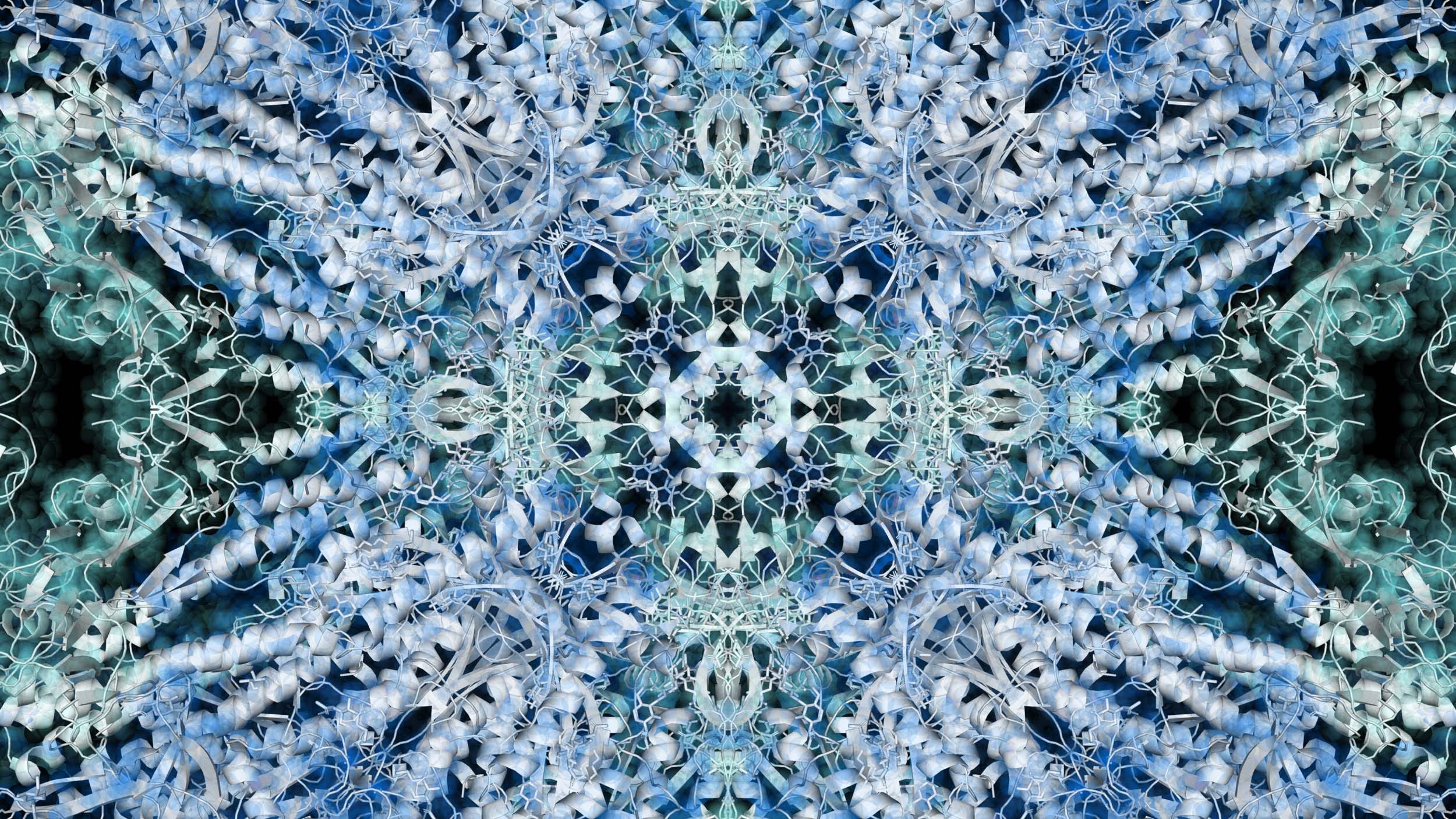
The Doilies series was part of my early experimentation in blending digital technologies with textile materialities, which continues in my practice today. Each computer-embroidered virus can be looked at as a lace doily—a culturally specific artifact associated with multiple value systems that encompass women’s work, invisible labor, craft commodities, and family heirlooms. But each doily can also be looked at as a scientific rendering of a unique molecular structure of a disease-causing virus. This liminality is what I find the most powerful, as it usually catches us by surprise before quickly realizing we can control that sensation—we can choose to see a virus or to see decorative lace needlework. We can choose to think of the doily as an autonomous artifact or as a technological subversion of a handicraft.
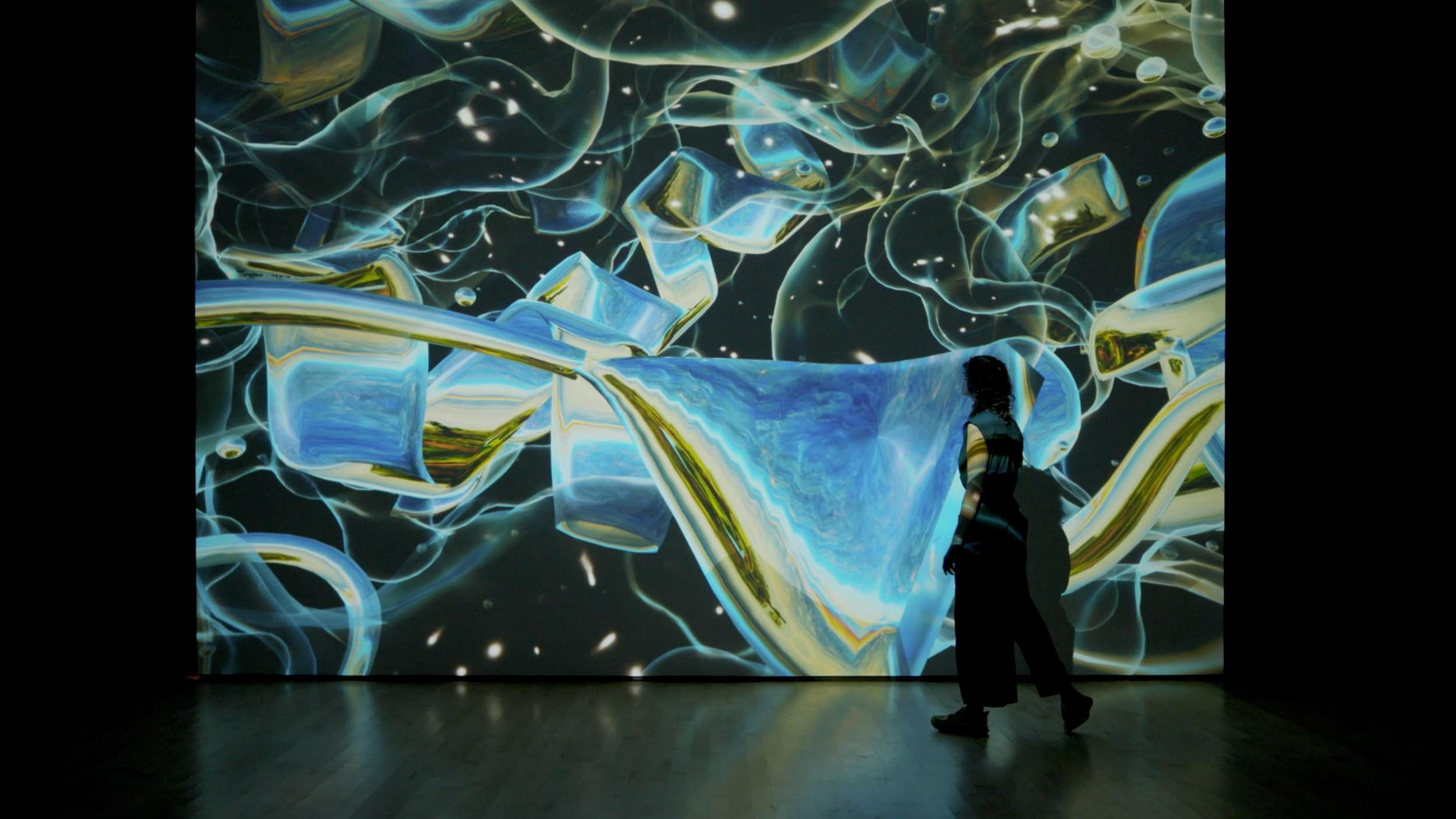
Although the tactility of the doily is part of its seduction, I’ve explored touch, haptics, interactivity, and interface in more explicit ways in many other projects in ways that I often refer to as the “tactical tactile”. The sensuality and intuitive nature of tactile experiences can engage viewers in ways that can be playfully inviting rather than distant or alienating. Recent projects have included more immersive encounters with ambient sound and scent, haptic vibration, and interactive gaming environments controlled by visitors’ movements. Increasingly, my work engages multiple senses as a shortcut to demonstrate interconnectedness and entanglement across macro and micro scales.
DE: As you’ve pointed out, you’ve employed lacemaking, embroidery, and weaving. These are techniques with a very specific gendered labor history. You’re using them to render viruses, biometric data, things with a hyper-technical register. I’m curious about the friction you’re creating between those two vocabularies.
LS: That friction is where the work comes alive, and the viewer can project their own sociopolitical narratives that may be grounded in a multitude of histories. I often combine signifiers of women’s work and domesticity with signifiers of spaces where women’s work has been systematically devalued, excluded, or erased.
The histories of scientific and technological innovation abound with women’s work that has been attributed to men or written out of the record. Reuniting techniques recognized as women’s work with imagery that registers as otherwise problematizes those assumptions and invites us to unpack them. But within the media and convention of textiles (patterns, weave structures, symbolic meaning, decorative motifs), I find a shared vocabulary with the technological (glitch, noise, resolution, and geometric abstraction). The mathematical patterns of woven Bargello wave patterns are great examples of this.
DE: More broadly, though, there’s a burden on art that engages in science to represent the information encoded in the work accurately. How do you resolve that?
LS: I’ve raised the question of scientific veracity in such projects as Blood Scarf (“How does it work?”, How much blood does it hold?”, “Is it real blood?”), or Manifest (“Is that a real smile?”). Often, these questions are less about mistrust of the artist and more about mistrust of the image by way of its multifarious connections, and their meanings, to the fields of art, science, and technology.
Lately, I’ve noticed the burden of representation of science in art has evolved within contemporary post-postmodern or metamodern perspectives that embrace speculative and critical explorations of these fields. As the stakes only get higher with increased systemic instability, I think everyone is hungry for new ways to understand the science behind systems and new ways to imagine alternative ways to engage with them. That is to say that the role of the image is at yet another inflection point in its technologically entangled history. We increasingly look to images less for their veracity and more for their possibility.
DE: Like many artists in the bioart space, you are often working alongside or in collaboration with scientists. I want to understand where the work actually lives in those exchanges. When you’re co-creating with a scientist who has deep domain knowledge you don’t have, and vice versa, how do you negotiate what the work’s actually about?
LS: I think my collaborative process is less about agreeing on what the work is about and more about agreeing on the nature of our collaboration. Some work emerges out of conversations about a particular biological process, some out of shared exploration of a particular laboratory technology, some out of a shared fixation on color in scientific imaging. As an artist, I don’t find deciding what the work is about before making it to be effective, and scientists know that innovation can be found in strange places (see: Alexander Fleming’s discovery of penicillin).
Interdisciplinary collaborations work best when exploring unfamiliar territory together with no specific agenda and a mutual comfortability with the possibility of failure. One thing artists and scientists share is a search for the novel. Discovering something new to both of us within unfamiliar territory is where the interdisciplinary exchange really begins.
However, I don’t know if it’s where the work lives. Most of my work that’s born out of collaboration takes much longer to produce than the duration of the collaboration itself. The research becomes “material” for artworks that may take years to materialize, mostly for logistical reasons around studio production schedules and fabrication resources. I’m still making artwork emerging out of research from collaborations done almost 10 years ago!
DE: That’s incredible and a testament to how long things take sometimes. I’ve been thinking a lot about the time required to think deeply, the pace of life, and how those seemingly opposing poles influence the work that I make. How do you know when something is done, or an idea is used up? Given the long tail of collaboration, is something ever put to rest fully?
LS: Time for deep thinking, wandering research, and inspired ideation is so crucial. I find this to be the most useful part of artist residencies. The connections between the ideas in my work have always felt fluid, so I can’t say I’ve ever consciously put any of them to rest, so to speak. And the thought of that is actually a little painful. I like to think I have the option to return to past ideas or forms if the appropriate circumstances arise. Much of my work has emerged out of fleeting circumstances (site-specific commissions, short-term residencies with equipment access, etc.) that often feel like a pause at their conclusion rather than put to bed. And since my work is often research-based and collaborative, the studio is a constantly shifting set of circumstances.
Pieces I made twenty years ago still speak to me conceptually and philosophically. However, I do see definitive aesthetic and material phases in my work as clearer delineations of past or fully explored approaches. My earlier work was a bit more overtly playful and humorous, whereas more recently, I like to nurture a more nuanced engagement that is grounded in the feelings of awe and wonder. Here though, absurdity sneaks up on you as a foil to the more complex themes in the work.
DE: Do you have a preferred cadence for working, putting art out into the world that feels both complementary to your creative process while also engaging with the demands of engaging in the wider community?
LS: My best work emerges out of invitations from curators at galleries, museums, and festivals for creating new work within some broad thematic context. One to two years is the ideal timeline from exploratory conversations to the final public presentation. I’ve worked with shorter production time frames plenty of times, too.
The trick is aligning your ideas and budget to the support and affordances at hand and resisting the urge to make an opportunity more than what it is. A work can simultaneously be the continuation of a previous body of work and the beginning of a new one. Not all ideas have to be contained within a single work.
DE: As as I see it, there’s a Venn diagram of creative risk, economic imperative, and the overlap is where sustainability emerges. From everything I know about your practice, you’ve created a hybrid approach to making a living that supports intellectually rigorous work, while also feeling financially sustainable. You teach, run a residency out of your studio, lecture, and exhibit widely. You seem to always be learning new tools and then effortlessly folding those new skills into your practice. From the outside, it seems like a well-oiled machine–is it really?
LS: My favorite part of being an artist is learning! If it weren’t for deadlines and budgets, I would just be doing coding, software, bobbin lace, and biotech lab tutorials in the studio all day. I’ve been fortunate to work with so many curators and foundations that have supported the experimental nature of my work and trust that it will lead to something compelling for each of us.
I’ve never been very risk-averse in life, and my best artwork has enthusiastically confronted what’s new or unfamiliar. Some of my favorite studio tinkering tests the edges of failure around materials and technology.
I suppose this starts with a “risky” question where failure seems imminent: Can I embellish remnant facial peel with computerized machine embroidery? Can I knit with vinyl tubing and run liquid through it? or materialize emotions? The most interesting work lies at a definitive yet precarious yes.
I think the answer to the well-oiled machine question depends on your risk tolerance. Cultural mythologies often dictate that creativity that is not commodifiable is what defines being a true artist. I firmly believe there are many ways to be an artist, and everyone defines risk differently.
For some context, I moved to New York City 20 years ago with no job, no gallery, and no place to live, driving from California in a 3-cylinder Geo Metro with one bookshelf, two cats, and a boyfriend who was also an unemployed artist. For me, it’s more important to be able to adapt to the inevitable wrenches in the gears than to have a well-oiled machine. None of this is to say my life is chaotic or that I seek chaos. Risk can be carefully managed, and anyone who has worked with me knows I have meticulous organizational habits that keep the machine running. Without my calendars, mind maps, and databases, the machine would stop.
A diversified practice has been a way of sustaining myself as an artist, not just financially but creatively. I started teaching right out of my undergraduate at BAVC MEDIA and quickly realized that I not only loved empowering artists with new skills, but that it gave me a facility and the agility with creative technology that was impacting every aspect of my art practice. I’ve continued to teach art in academia at schools like Stanford University and Hunter College. Speaking about my work and advising students as a visiting artist is also a great opportunity to share my work and process more deeply. These experiences are part of what led me to create the Plexus Projects residencies to support other artists with the practical skills involved in creating a practice that is sustainable for each artist’s unique circumstances. It’s not so much about imparting the rules of any system as sharing options and resources that many artists don’t realize are available to them and empowering them to use them.
All of that said, I do recognize the privilege behind taking creative and professional risks. Having access to communities that support and understand your work is the most essential part of a sustainable practice. Systems are people, and most opportunities will probably come from people you already know.
DE: I’ve personally benefited from what you’ve offered through Plexus Projects many times over! I agree that whatever models artists use to support their practice should probably be community-minded and sit outside of traditional markets or institutions that are directly influenced by those markets. I think we undervalue all the ways we can support ourselves and others through art-making because oftentimes financial support overshadows some of the more enduring yet no less important elements of being an artist. What have you learned from running Plexus Projects both about yourself, the artists you’ve supported, and the economy of art more broadly?
LS: I’ve learned so much from these different curatorial projects. With the exhibitions, it’s been so generative to connect with artists interrogating shared themes and interests with thematic shows like GUI/GOOEY. Many artists in my group exhibitions have gone on to participate in the residencies, which have deepened our connection in unanticipated ways.
With the remote residencies, I’ve seen how hungry artists are for candid feedback and honest insights about their work and how they communicate it. With the studio residencies, I’ve realized how many artists need access to studio space with an easier lift. Studio residencies in general offer studio access without the burdens of insurance, credit checks, long-term leases, etc. The Plexus Projects studio residency is unique in providing time and space for artists’ self-directed exploration in a gallery-style space where they can both produce and document work, have studio visits, or just sit in a chair and read. With all these curatorial activities, I’ve learned that I enjoy creating spaces where artists can share their ideas and seeing the seeds that are planted in doing so. Early in my creative life, I also did this through zines and public access television shows that featured art and artists. So many long-lasting relationships sprouted from these projects!
DE: I’ve heard many artists feel disillusioned right now, not only by the masses of images circulated in the world and on the internet, but also by the ease of making said images. Not to mention the economic pressures we’ve already discussed. I don’t know if I’m disillusioned, per se, but I have found myself wanting to write and read more. Walk in silence and stay offline longer. Has the ease of production, the AI slop, and the more-is-more aspect of art affected how you make work or what you make? Do these things affect you, and in what way?
LS: I also find writing to be a solace. Writing without the assistance of AI or even a search engine is now a novelty and makes me feel more human, less networked, less surveilled, and more reflective on what makes me, as a human, both unique (when I write something good) and mundane (when I write something boring). I find myself now consuming all types of media, whether they’re created before AI, or after. None of these is a value judgement in, though. So much of what is obviously created with AI or is even AI slop brings me amusement and even joy.
I’m not disillusioned by any masses of images themselves or by the ease of making any images. I’m disillusioned by how images are consumed and metabolized by culture and how the lack of media literacy affects that consumption.
In fact, to be disillusioned by the circulation of images or the ease of making images strikes me as a bit undemocratic and art world gatekeeping. Everyone should be empowered to make and distribute images and any other kind of cultural production. And if artists feel threatened by that, they should adapt. In the same way that photography did not kill painting, AI will not kill art. AI requires us to redefine what art is, can be, and who can be an artist.
But it’s important to distinguish what AI can do (easy production, viral circulation, proliferation of slop aesthetics) from how AI tools are created (environmental devastation, data theft, privacy infringement, surveillance, IP violations). These two aspects are inextricably connected, but I have completely different feelings about each, and each has affected me in completely unrelated ways. The artist in me has so much love for the creative potential of AI tools. However, the social, political, and economic machinations behind the development, regulation, and deployment of AI have been unnecessarily disastrous.
I wouldn’t say the ease of generative AI, or the abject qualities of AI aesthetics (slop, hallucinations, sycophancy) have affected my work any differently than other technologies, though. I am always looking for ways to creatively disrupt, co-opt, and destabilize new tools by misusing them or even coaxing them to fail.
I’ve been exploring that in my recent work, like Baroque Bodies, where I inject text prompts with scientific studies in order to generate landscape “photographs” to explore conflations of past and present at biological and technological scales.
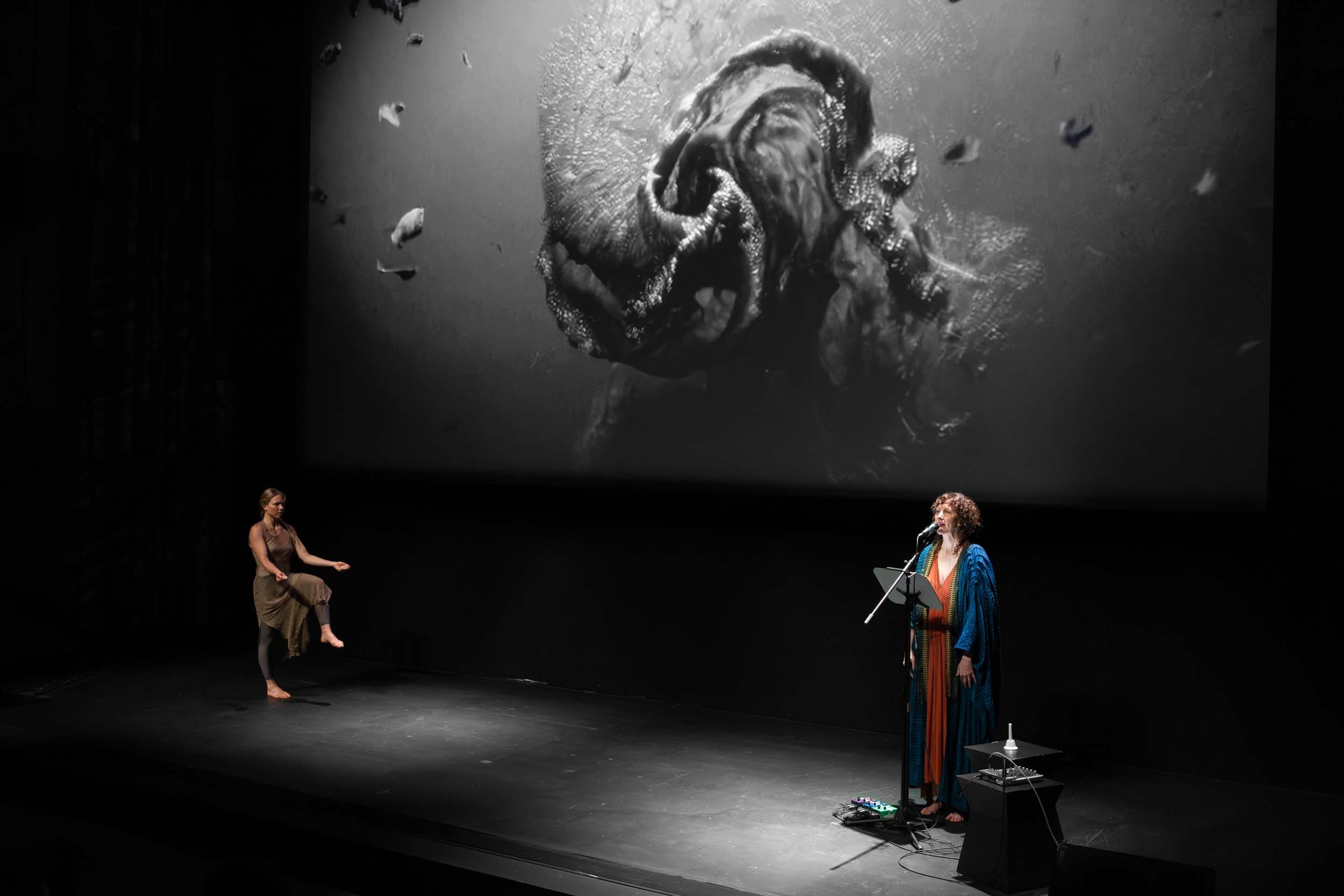
In Cryptic Lineages, I’ve been cloning my own voice, vibe coding data-driven soundscapes, and generating pseudo-documentary video footage to create speculative narratives exploring biological computing alternatives to current AI data center infrastructures. I’ve always been fascinated with technological translations of the natural world, and the layers of translation involved in generative AI are worth unpacking.
DE: What does an ideal art world look like? Which is to say, what do you need to be happy and to feel like your practice is sustained, and do any of those personal wants translate into a more universal approach?
LS: I spend more time thinking about my collaborators, supporters, and colleagues within the communities that I’m connected to, rather than the “art world” per se, even though many of them are indeed “insiders”. I suppose for me the ideal scenario nurtures activities and conversations that extend beyond the gallery walls and enrich as many communities as possible.
To feel sustained and supported, I most importantly need honesty and integrity. My happiest art world memories are ones where everything went smoothly because everyone simply did the things they agreed to do by the date they said they would do them. I can work within a wide range of constraints, but it’s less painful for everyone if we all know what they are from the beginning.
Communication and transparency are constantly moving targets within systems that are built on rarity, exclusivity, luxury, provenance, trend, and cults of personality. The art world has always been its own special kind of black box. As increasing economic disparity perpetuates secrecy and gatekeeping, I don’t expect that to change. But I’m optimistic about how artists can uniquely respond with whatever tools are at hand while also questioning the tools themselves.